
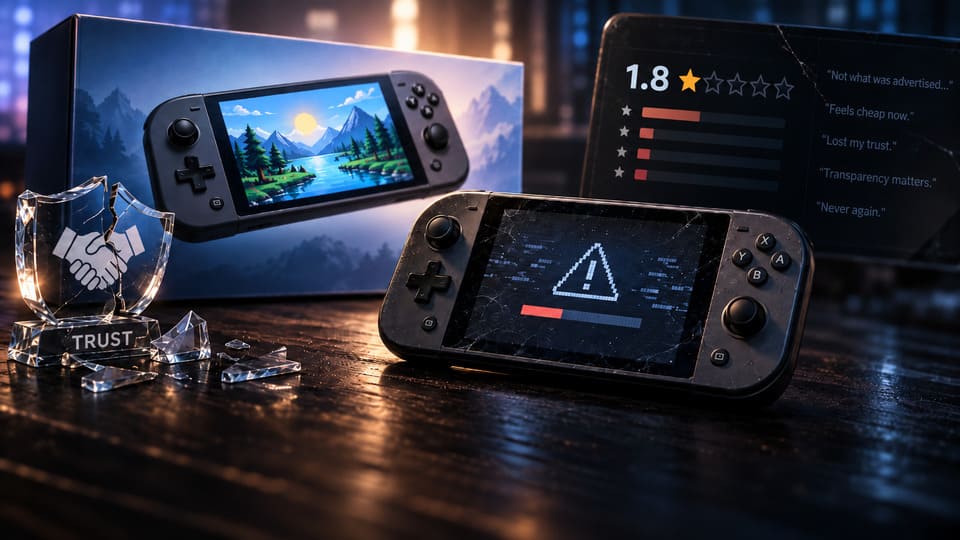

Transparency in gaming becomes urgent when a popular handheld brand suddenly loses buyer confidence. The problem is not only online noise. The real pain comes later: unclear specs, mismatched expectations, returns, bad reviews, and frozen inventory. For B2B buyers, the solution is simple but not easy: verify before you buy.
For importers, wholesalers, and ecommerce sellers, transparency in gaming means clear product information before payment: configuration, system version, game list, accessories, packaging, batch details, QC process, and delivery plan. A hot product is not enough. Buyers need proof that the product is commercially safe to sell in their market.
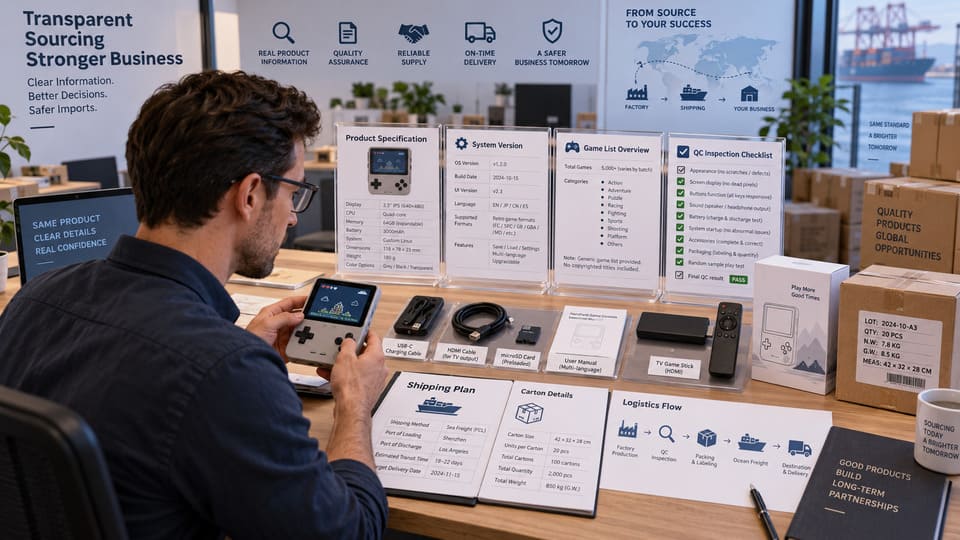
I will not analyze or accuse any specific brand here. I do not have inside information, and most buyers do not need drama. They need a better sourcing checklist. From my daily communication with overseas buyers, trust is built by details, not slogans.
Why Is Transparency in Gaming a Sourcing Risk-Control Tool?
Many buyers first ask about the hottest model, best-looking shell, or lowest price. That is understandable. But when transparency in gaming is missing, the buyer may not know what they are really importing.
The short answer: transparency reduces disputes1. It helps buyers confirm what is included, what performance to expect, what the customer will receive, and what after-sales risks may appear after the products enter the market.

In B2B sourcing, “it can run” is not the same as “it is safe to sell.”2 A handheld console may look great in a short video. It may also have unclear firmware, different memory options, changed buttons, missing accessories, or packaging that does not match the listing.
I often see buyers compare only by price. Then they discover later that two suppliers are not quoting the same thing.
A practical check should include:
- Chipset and RAM/storage configuration
- Screen size and resolution
- Battery capacity
- System version and language support
- Game list format and category
- Accessories included
- Packaging type
- Logo or private-label options
- Batch difference risk
- Warranty and spare parts policy
| Buyer Question | Why It Matters |
|---|---|
| Is this the latest batch? | Hardware or packaging may change. |
| Can I see real photos/videos? | It reduces listing mismatch. |
| What is tested before shipment? | It supports return-rate control. |
| Can I order a sample first? | It protects larger orders. |
What Should Buyers Verify Before Ordering Handheld Consoles?
Buyers should verify the full sales promise, not only the device body. A customer does not receive a “spec sheet.” They receive a box, cable, manual, menu system, game list, and user experience.
The answer is: confirm everything that affects customer expectation. If a detail appears in your online listing, retail package, or sales pitch, it should be confirmed with the supplier before bulk order.
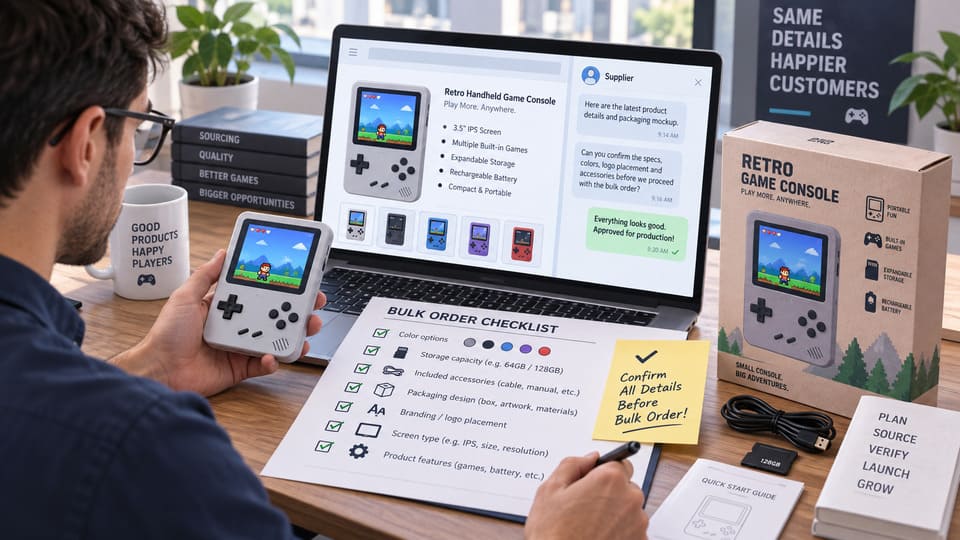
From our B2B communication experience, most disputes come from small details that were never written clearly3. For example, a buyer may expect a certain game quantity, but the supplier quotes a different card. Another buyer may expect English packaging, but the stock packaging is neutral or mixed-language.
Before placing an order, I suggest asking:
- Can you confirm the exact model and configuration?
- Can you provide real photos of the current batch?
- Can you show a boot-up video and menu video?
- What accessories are inside the box?
- Can I customize logo or packaging?
- What QC steps are done before shipment?
- What happens if defective units appear?
This is not about making the supplier uncomfortable. A qualified supplier should prefer clear communication. It protects both sides.
A good quote should not be only “USD X per unit.” It should explain what is included, what MOQ applies, what lead time is realistic, and what customization changes the price.
How Does Transparency in Gaming Protect Reviews and Margin?
A buyer’s margin is not only the difference between cost and selling price.4 Returns, refunds, bad reviews, platform complaints, and slow-moving stock also reduce profit. That is why transparency in gaming matters after the shipment arrives.
The answer: transparent sourcing helps buyers avoid expectation gaps. When the product page, package, and real device match each other, customers are less likely to complain or return the item5.

For Amazon sellers, ecommerce shops, and distributors, the risk is often commercial, not technical. A console may power on and play games, but still fail the market if the customer expected something else.
Common problems include:
- The listing says one version, but the shipped batch is different.
- The game list is not explained clearly.
- The packaging image does not match delivered goods.
- The battery life claim is too aggressive.6
- The buyer did not test a sample before scaling.
- The supplier did not explain stock changes in time.
I always prefer when buyers tell me their target market first. A Latin America distributor may care more about Spanish menu support and durable packaging. A European ecommerce seller may care more about CE-related documents, product labeling, and stable after-sales handling. An Amazon seller may care most about review risk and listing accuracy.
This is why the supplier should ask questions before quoting. A fast quote is useful, but a correct quote is safer.
Frequently Asked Questions
Is a hot handheld console brand always safe for wholesale?
No. A hot brand may sell quickly, but buyers still need to verify configuration, batch stability, packaging, accessories, and after-sales support. Market heat can create demand, but it does not remove sourcing risk.
Should I choose the lowest-priced supplier?
Not automatically. The lowest price may exclude accessories, use a different configuration, or offer weaker QC support. Buyers should compare the same product details before judging price.
Is a sample order necessary?
Yes, in most cases. A sample helps buyers check real performance, packaging, menu language, accessories, and customer experience before ordering larger quantities.
What proves a supplier is transparent?
Useful proof includes clear specifications, real photos, videos, sample support, written order details, QC steps, packaging confirmation, and honest communication about lead time or batch changes.
Conclusion
Transparency in gaming is not just a nice value after a brand trust crisis. It is a practical buying tool for importers, wholesalers, distributors, and online sellers. Buyers should verify the product, supplier, batch, packaging, QC process, and delivery plan before chasing the lowest price or hottest model. If you are sourcing retro handheld consoles, I suggest starting with a sample, a written specification sheet, and clear supplier communication before scaling your order.
"An Empirical Study of Dispute Resolution Clauses in ...", https://cdn.vanderbilt.edu/vu-wp0/wp-content/uploads/sites/78/2019/05/25134536/6.20Coyle20.pdf. Procurement guidance from trade and purchasing institutions generally treats clear specifications, documented requirements, and written acceptance criteria as controls that reduce ambiguity and the likelihood of supplier-buyer disputes. Evidence role: general_support; source type: institution. Supports: Institutional or research guidance that clear specifications, written requirements, and documented supplier obligations reduce ambiguity and dispute risk in procurement.. Scope note: The support would be contextual to procurement practice rather than specific to handheld gaming consoles. ↩
"Retailers: Product Safety and Your Responsibilities", https://www.cpsc.gov/Business--Manufacturing/Business-Education/Business-Guidance/Retailers-Product-Safety-and-Your-Responsibilities. Government product-compliance guidance distinguishes functional operation from legal marketability, noting that importers and sellers may be responsible for safety, labeling, documentation, and conformity requirements before a product is placed on the market. Evidence role: general_support; source type: government. Supports: Government guidance that saleability depends not only on whether a product works but also on compliance with applicable safety, labeling, documentation, and importer obligations.. Scope note: The relevance depends on the destination market and the specific regulatory category of the device. ↩
"Differential awareness, ambiguity, and incomplete contracts", https://ageconsearch.umn.edu/record/151200/. Contract-management research and procurement guidance commonly identify ambiguous specifications and incomplete written requirements as factors that increase disagreement over performance, acceptance, and remedies. Evidence role: general_support; source type: research. Supports: Research or institutional guidance linking ambiguous or incomplete contract specifications with increased dispute risk.. Scope note: This would support the general dispute mechanism, not quantify the proportion of disputes in handheld-console sourcing. ↩
"Opportunistic Returns and Dynamic Pricing: Empirical ...", https://www.hbs.edu/ris/Publication%20Files/19-030_39bfa9af-36e1-4956-a9cd-01024f50122b.pdf. Research on retail returns and reverse logistics shows that profitability is affected by handling costs, refunds, restocking, lost sales value, and related operational expenses, not merely by the gap between wholesale cost and selling price. Evidence role: general_support; source type: paper. Supports: Academic research showing that product returns and reverse-logistics costs affect retailer profitability beyond the initial gross margin calculation.. Scope note: The magnitude of the effect depends on category, platform policies, return condition, and resale value. ↩
"Determining the Effect of the Returns Management ...", https://trace.tennessee.edu/cgi/viewcontent.cgi?referer=&httpsredir=1&article=2592&context=utk_chanhonoproj. Expectation-confirmation research indicates that consumers evaluate purchases partly by comparing expected attributes with actual performance; larger mismatches are associated with dissatisfaction and can increase complaints or return intentions. Evidence role: mechanism; source type: paper. Supports: Consumer-behavior evidence that satisfaction is influenced by the match between expectations and received product attributes, with mismatches associated with complaints or returns.. Scope note: This supports the behavioral mechanism but does not establish a specific return-rate reduction for handheld consoles. ↩
"FTC Policy Statement Regarding Advertising Substantiation", https://www.ftc.gov/legal-library/browse/ftc-policy-statement-regarding-advertising-substantiation. Advertising-substantiation guidance treats objective performance statements, including claims about product duration or capacity, as claims that should be truthful, not misleading, and supported by adequate evidence before use in marketing. Evidence role: general_support; source type: government. Supports: Regulatory guidance that objective performance claims, such as battery-life statements, should be truthful and supported by adequate evidence.. Scope note: The guidance supports the need for substantiation but does not define a universal test protocol for every handheld device. ↩