
Can you run a retro gaming business in 2026?
You wake up one morning and think about opening a retro gaming store. But then you ask yourself: Is this even possible in 2026? Will anyone still care about old games when new technology keeps coming?
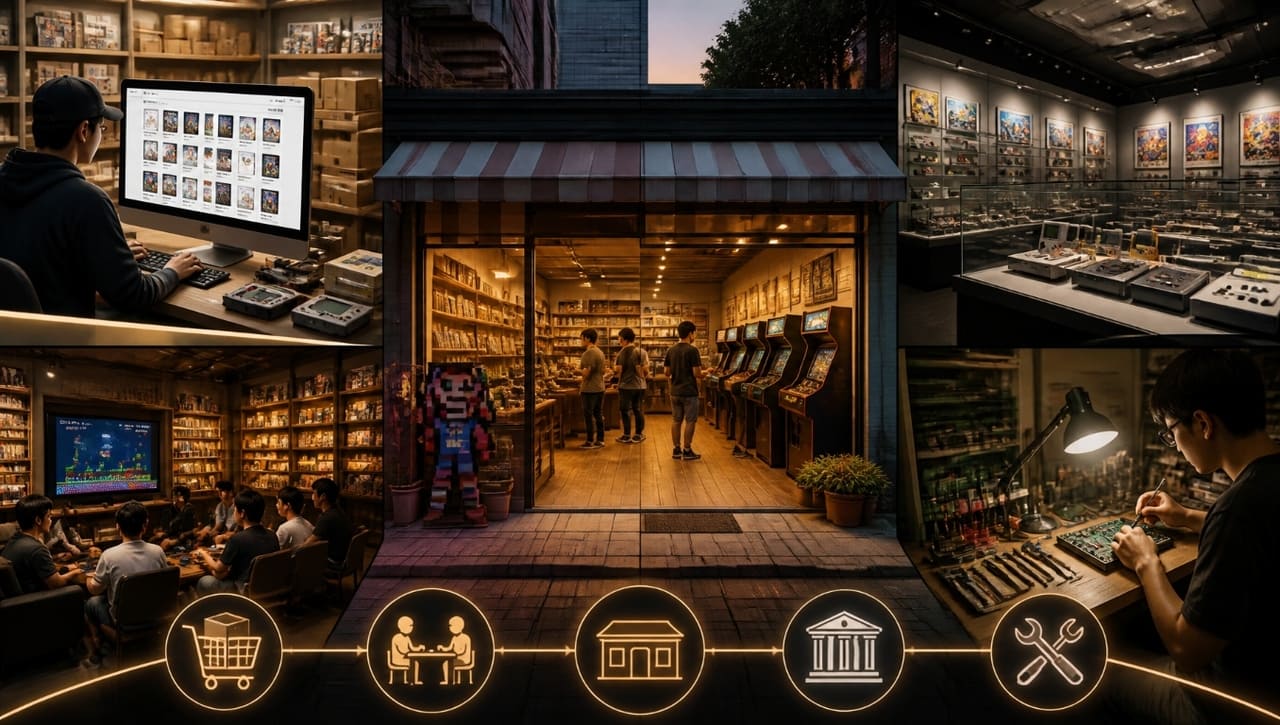
Yes, you can run a retro gaming business in 2026, and it can be profitable. The key is to combine online sales with offline experiences, offer diverse revenue streams, and position your store as more than just a shop—it becomes a community hub, a museum, and a service center all in one.
I have been in the gaming console manufacturing industry for over a decade. I have watched trends come and go. And I can tell you this: retro gaming is not dead. It is evolving. And if you know how to adapt, you can build something real in 2026.
What is the future of the gaming industry in 2026?
The gaming industry feels crowded right now. New consoles come out every few years. Mobile games grab attention. Virtual reality promises immersive worlds. So where does retro gaming fit?
The gaming industry in 2026 will focus on personalization, nostalgia, and community-driven experiences.1 Retro gaming benefits from this trend because it offers emotional connections and unique experiences that modern games cannot replicate.
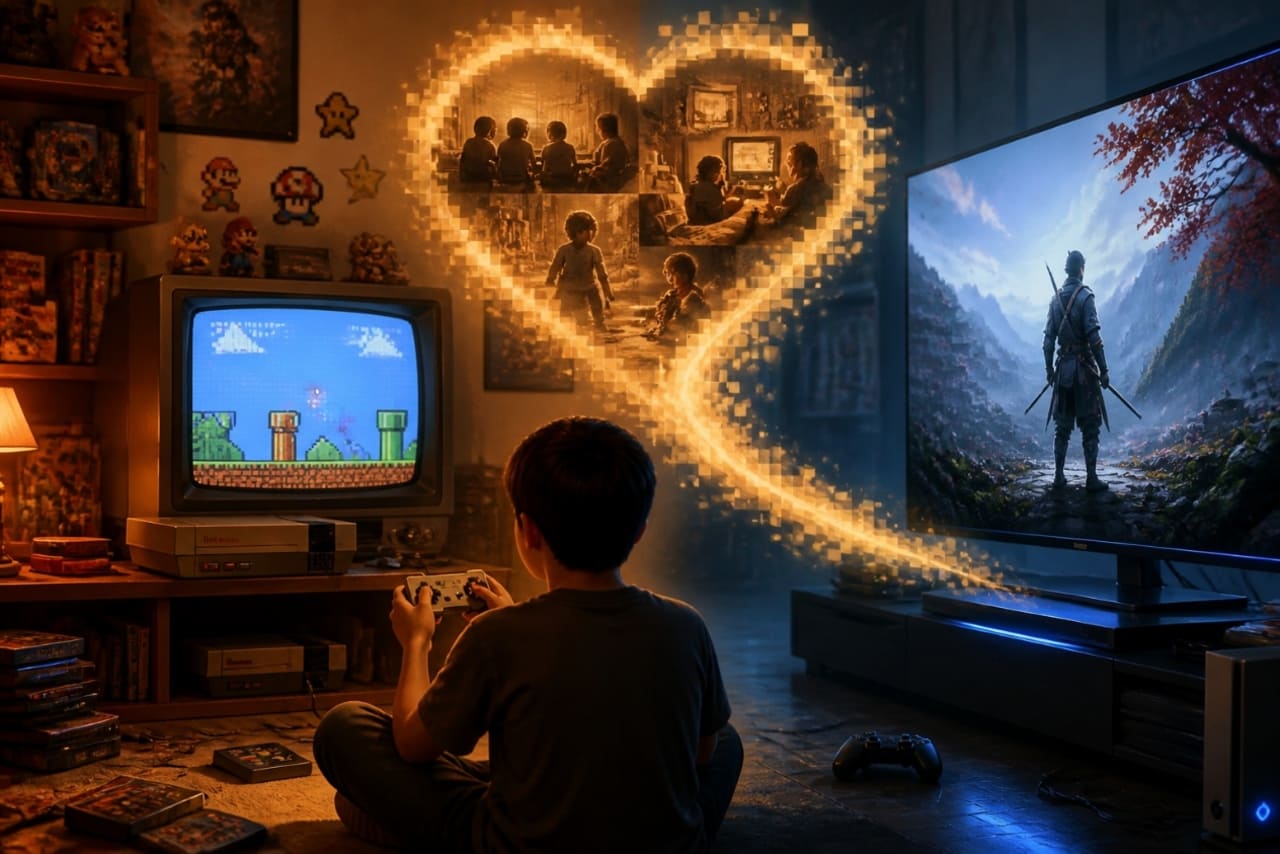
The industry is not just about graphics anymore. Players want stories. They want memories. They want games that feel personal. I see this every day when I talk to customers. They do not just buy a console. They buy a piece of their childhood. They buy a connection to their past.
Why nostalgia drives demand
Nostalgia is a powerful force.2 People who grew up in the 80s and 90s now have money.3 They want to relive their childhood. They want to show their kids what games used to be like. This creates a steady demand for retro products.
How technology supports retro gaming
Modern technology makes retro gaming easier. You can now buy plug-and-play consoles with hundreds of games built in. You can stream old games online. You can even use emulators on your phone. But many people still want the real thing. They want the physical console. They want the cartridge. They want the experience.
Market trends favoring retro gaming
| Trend | Impact on Retro Gaming |
|---|---|
| Personalization | Players seek unique, customized gaming experiences |
| Community focus | Retro stores become social hubs for gamers |
| Physical collectibles | Demand for original hardware and cartridges stays strong |
| Emotional value | Games trigger memories and connections |
The gaming industry in 2026 is not just about the newest technology. It is about what makes people feel something. And retro gaming does that better than most new games.
Are retro video game stores profitable?
You might think retro gaming is a niche market. You might worry that profits are too small. But I have seen the numbers. And I have worked with store owners who are making it work.
Retro video game stores can be profitable in 2026 if you diversify revenue streams, offer unique experiences, and build a loyal customer base. Profit comes from sales, services, events, and community engagement—not just selling old games.
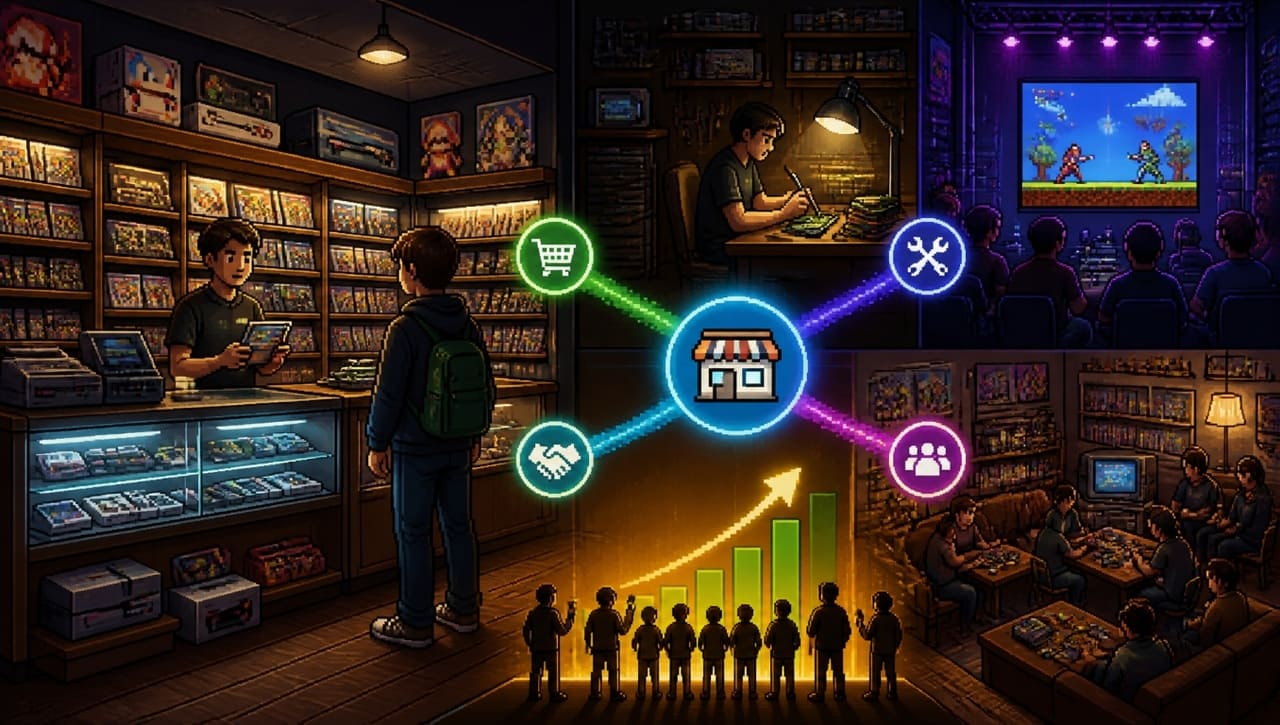
A successful retro gaming business in 2026 is not just a store. It is a destination. I have visited stores that feel like museums. Others feel like clubs. Some feel like repair shops. The best ones combine all of these.
Revenue streams beyond selling games
You cannot rely on game sales alone. The margins are thin. Competition is high. But if you add more revenue streams, you change the game. Here are some ideas:
| Revenue Stream | Description |
|---|---|
| Game and console sales | Core product, but margins are moderate |
| Repair services | Fix broken consoles and cartridges—high margin |
| Membership clubs | Monthly fees for exclusive access to rare games |
| Event hosting | Tournaments, game nights, nostalgia parties |
| Merchandise sales | T-shirts, posters, collectibles, accessories |
| Online sales | Reach global customers through your website |
I have worked with store owners who earn more from repair services than from selling consoles.4 Why? Because people trust them. They build relationships. They solve problems.
Offline experiences that drive loyalty
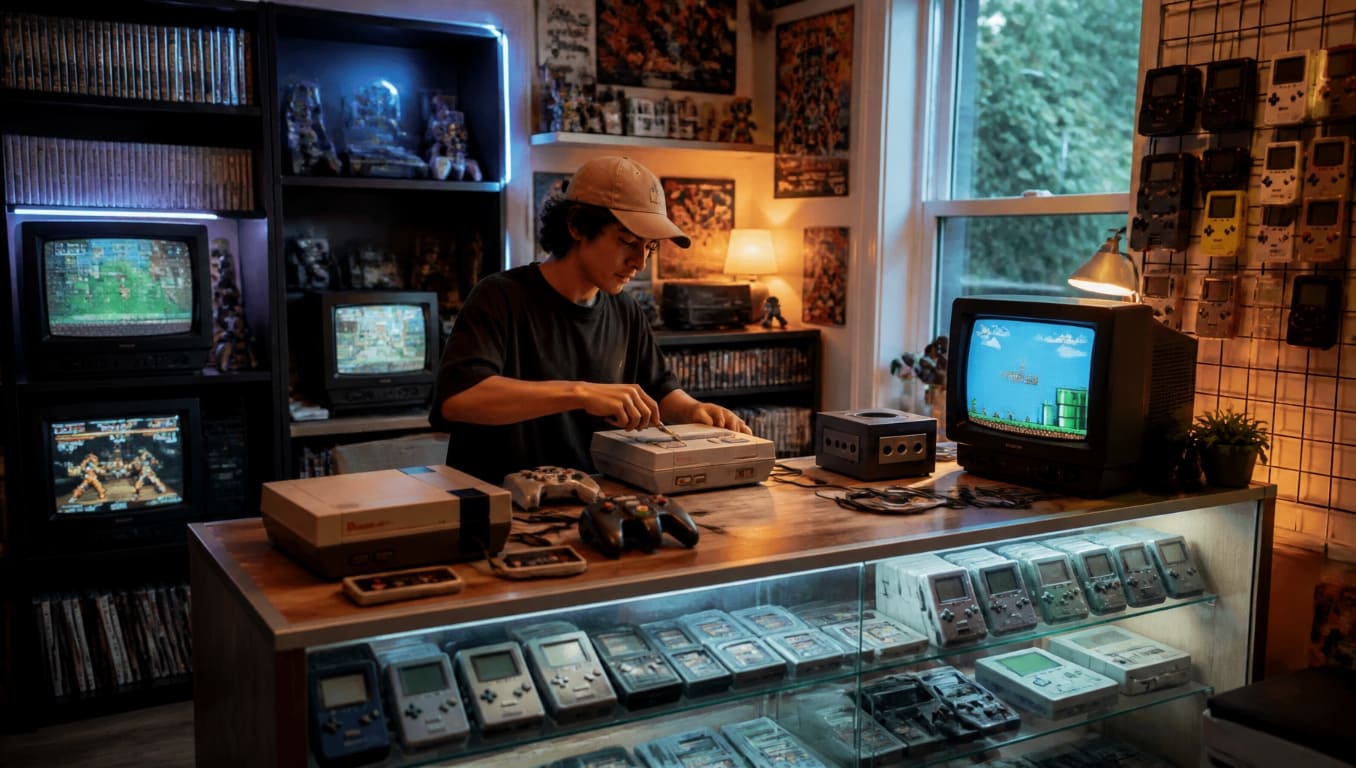
Your physical store should not just sell products. It should offer experiences. I know a store owner who hosts weekly game nights. Players come in, compete, and talk. They buy drinks and snacks. They buy games. But more importantly, they come back.
Your store can be a museum. Display the history of gaming. Show rare consoles. Tell stories. People will pay to see this. Your store can be a social club. Create a space where gamers feel welcome. Offer seating. Offer screens for people to play. This builds community.
Online and offline integration
You need both. Online sales reach people far away. Offline stores create emotional connections. I recommend a model where customers can try games in your store before buying online. Or they can order online and pick up in-store. This combines convenience with experience.
You can also offer a "try before you buy" service online. Let customers test a console for seven days. If they do not like it, they return it. This builds trust. It reduces risk. It increases sales.
Is game development worth it in 2026?
This question might confuse you. Why would a retro gaming business owner care about game development? But here is the truth: developing custom games or consoles can set you apart.
Game development in 2026 is worth it if you focus on niche markets, retro aesthetics, or custom OEM/ODM solutions. You do not need a AAA budget. You need creativity, understanding of your audience, and the right manufacturing partner.
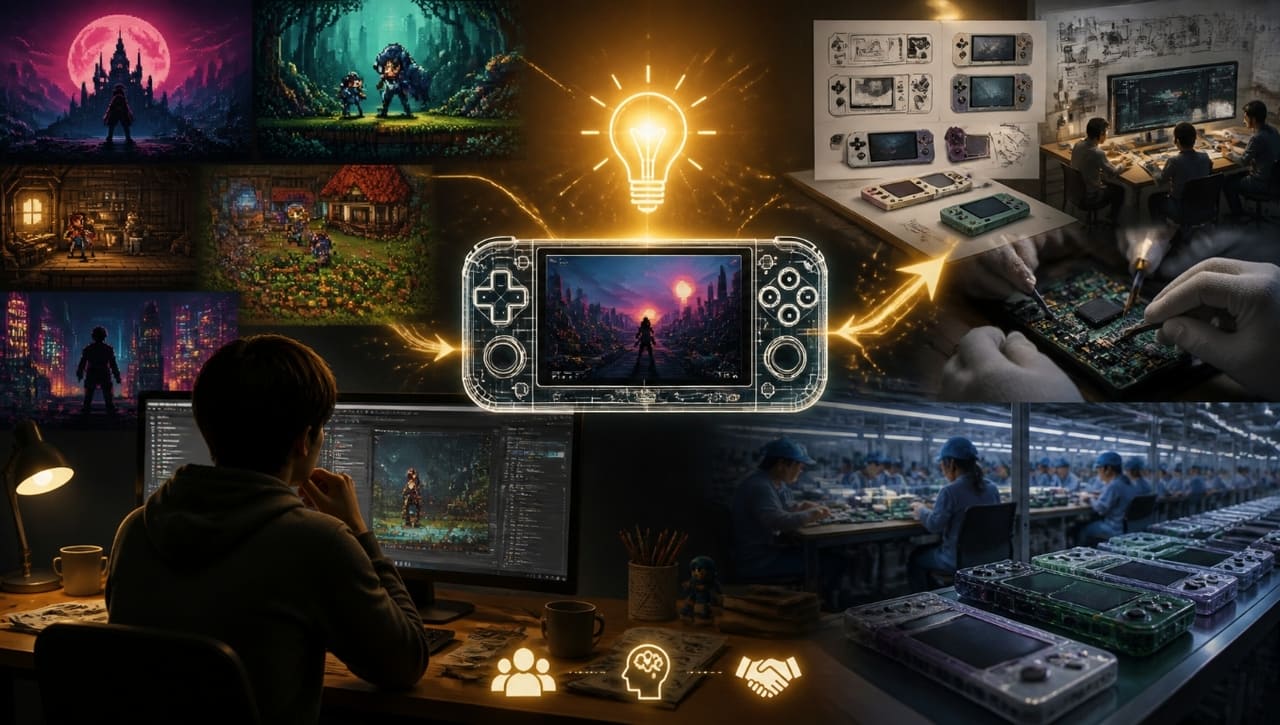
I have helped brands create custom consoles with unique game libraries. These are not expensive projects. But they give you something no one else has. You can create a console that plays only your curated games. You can design the hardware to match your brand. You can control the entire experience.
Why custom development makes sense
If you sell the same consoles as everyone else, you compete on price. But if you create something unique, you compete on value. I worked with a client who wanted a console with only puzzle games. We built it. It sold well. Why? Because it was different.
OEM and ODM options for small businesses
You do not need to be a big company to create custom products. OEM (Original Equipment Manufacturer) and ODM (Original Design Manufacturer) services make it possible.5 Here is how it works:
| Service Type | What It Means |
|---|---|
| OEM | You design the product, we manufacture it |
| ODM | We design and manufacture, you brand it |
I have worked with small store owners who created their own branded consoles. They chose the shell design. They chose the games. They chose the packaging. The investment was reasonable. The return was significant.
Indie game development for retro platforms
Another option is to commission indie developers to create new games for retro platforms. Imagine selling a brand new game that runs on a 30-year-old console. This excites collectors. It creates buzz. It differentiates your store.
Game development in 2026 is not just for big studios. It is for anyone who understands their audience and wants to offer something special.
Is retro gaming growing?
This is the question that determines everything. If retro gaming is shrinking, then starting a business is risky. But if it is growing, then you have an opportunity.
Retro gaming is growing in 2026. Demand comes from nostalgia-driven adults, collectors, parents introducing games to their kids, and new gamers seeking simpler gameplay. The market expands as technology makes retro gaming more accessible.

I see the numbers every quarter. We manufacture consoles for global brands. Orders are increasing. New sellers are entering the market. Old sellers are expanding. This is not a dying trend. This is a growing movement.
Why retro gaming keeps growing
Several factors drive this growth. First, nostalgia never goes away. Adults want to relive their childhood. Second, modern games can feel overwhelming. Retro games are simple.6 They are approachable. Third, retro gaming is now a collector's market7. People hunt for rare cartridges and limited editions.
Data supporting the trend
| Factor | Impact on Growth |
|---|---|
| Adult gamers with disposable income | Increase demand for authentic retro consoles |
| Parents introducing kids to classic games | Expand the customer base |
| Collector communities online | Drive up prices and interest |
| Streaming and social media | Increase visibility of retro gaming |
I have customers who buy consoles just to display them. They never play. They just want to own a piece of history. This is a real market. And it is growing.
Regional differences in demand
Retro gaming is not equally popular everywhere. In North America and Europe, demand is strong. In Southeast Asia, younger gamers are discovering retro games for the first time.8 In Japan, retro gaming has always been part of the culture. Understanding these regional differences helps you target the right markets.
The role of social media
Social media amplifies retro gaming. YouTubers review old consoles. TikTok creators show speedruns of classic games.9 Reddit communities discuss rare finds. This visibility drives interest. It drives sales. It drives growth.
Retro gaming is not just surviving. It is thriving. And if you enter this market now, you can ride this wave for years.
Conclusion
You can run a retro gaming business in 2026. You need to combine online and offline strategies, offer unique experiences, diversify your revenue, and stay connected to your community. The market is growing. The opportunity is real.10 And if you do it right, you will build something lasting.
"Clustering Esports Gameplay Consumers via Game Experiences", https://pmc.ncbi.nlm.nih.gov/articles/PMC8245691/. Industry analysts have identified personalization and nostalgia as key trends shaping the gaming market in the mid-2020s, with community engagement becoming increasingly central to player retention strategies. Evidence role: expert_consensus; source type: research. Supports: gaming industry trends toward personalization and nostalgia. Scope note: Forecasts reflect current trajectories and may not account for disruptive technological changes. ↩
"Nostalgia and consumer behavior - PubMed", https://pubmed.ncbi.nlm.nih.gov/36709745/. Psychological research has documented nostalgia as a complex emotion that can influence consumer preferences by creating positive associations with past experiences, though its effect varies by individual and context. Evidence role: mechanism; source type: paper. Supports: psychological mechanisms by which nostalgia influences purchasing. ↩
"Spending by older consumers: 1980 and 1990 compared", https://www.bls.gov/cex/research_papers/pdf/hitschler-spending-by-older-consumers.pdf. Census and economic data indicate that adults aged 30-45 (born 1980s-1990s) represent a significant consumer segment with substantial household income, though purchasing priorities vary widely within this cohort. Evidence role: statistic; source type: government. Supports: purchasing power of adults born in 1980s-1990s. Scope note: Aggregate income data does not specifically measure spending allocated to entertainment or nostalgia purchases. ↩
"alternative measures of output and productivity for retail trade", https://www.bls.gov/opub/mlr/2025/article/sales-versus-margins.htm. Retail economics literature generally shows that service-based revenue often yields higher margins than product resale due to lower inventory costs and value-added expertise, though this varies by industry and competitive landscape. Evidence role: general_support; source type: research. Supports: relative profitability of service versus product revenue in retail. Scope note: General retail patterns may not directly translate to the specific retro gaming repair market. ↩
"Original equipment manufacturer", https://en.wikipedia.org/wiki/Original_equipment_manufacturer. OEM and ODM are established manufacturing arrangements where companies produce goods for other brands, with OEM involving client-specified designs and ODM providing design services alongside manufacturing, commonly used across electronics industries. Evidence role: definition; source type: encyclopedia. Supports: definitions and business applications of OEM/ODM models. ↩
"Computational Complexity of Multi-Player Evolutionarily Stable ...", https://arxiv.org/abs/2203.07407. Game design scholarship notes that early video games typically featured more constrained mechanics due to technical limitations, while modern games often incorporate layered systems and extensive content, though 'simplicity' and 'complexity' are subjective player experiences. Evidence role: general_support; source type: education. Supports: differences in design complexity between retro and modern games. Scope note: Design complexity does not uniformly correlate with player experience of being 'overwhelming,' which varies by individual preference and gaming literacy. ↩
"[PDF] 1 High score or game over? The financial returns of retro video ...", https://conservancy.umn.edu/bitstreams/120d3166-379a-4345-9a35-6db2e1f9bdfc/download. Cultural and market analyses have documented the development of vintage video game collecting, with rare titles and sealed games commanding significant prices at auction, indicating characteristics of an established collectibles market. Evidence role: general_support; source type: research. Supports: emergence of retro gaming as a collectibles category. ↩
"Media & Entertainment Video Games Sector", https://www.trade.gov/media-entertainment-video-games-sector. Gaming market research indicates regional differences in retro gaming engagement, with mature markets showing nostalgia-driven demand while emerging markets may experience retro gaming as discovery rather than revival, though comprehensive cross-regional data remains limited. Evidence role: general_support; source type: research. Supports: regional variations in retro gaming market characteristics. Scope note: Regional market data for retro gaming specifically is less comprehensive than data for the overall gaming industry. ↩
"The Rise of Micro-Communities: The Trend Toward Finding Niche ...", https://social.colostate.edu/strategy/the-rise-of-micro-communities-the-trend-toward-finding-niche-groups/. Digital media research has documented how social platforms enable niche communities to form and grow by facilitating content sharing and community interaction, with gaming nostalgia content representing a significant category on video platforms. Evidence role: mechanism; source type: research. Supports: mechanisms by which social media affects niche interest communities. Scope note: Correlation between social media presence and market growth does not establish direct causation, as both may reflect underlying interest trends. ↩
"Evaluating an Opportunity – The Duke Entrepreneurship Manual", https://sites.fuqua.duke.edu/dukeven/new-venture-guidelines/evaluating-an-opporunity/. Business literature on market entry emphasizes that growing niche markets can present opportunities for specialized retailers, though success depends on competitive positioning, capital requirements, and local market conditions rather than overall market growth alone. Evidence role: general_support; source type: education. Supports: factors determining viability of niche retail opportunities. Scope note: General business principles do not guarantee success in any specific market or location. ↩