
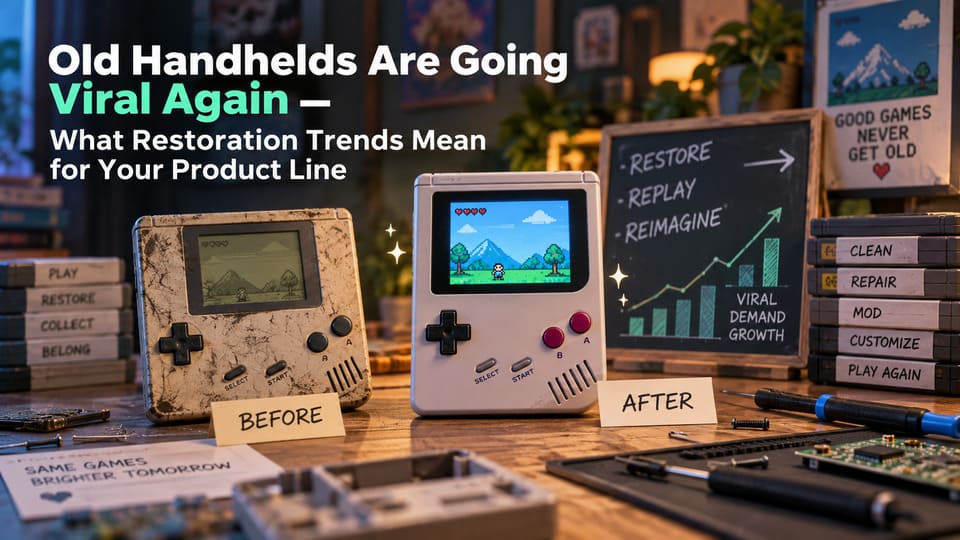

Old handhelds are going viral again, and I often see buyers asking whether this means they should add retro gaming products fast. The problem is that viral attention can feel like guaranteed demand1. That can lead to risky buying. The better solution is to treat restoration content as a demand signal, not a sourcing plan2.
Old handhelds going viral means nostalgic gaming is back in buyers’ minds, but it does not mean refurbished vintage devices are the best wholesale product. For importers, wholesalers, and e-commerce sellers, the safer move is to test newly produced retro handheld consoles with stable supply, controlled quality, clear packaging options, and manageable after-sales risk.
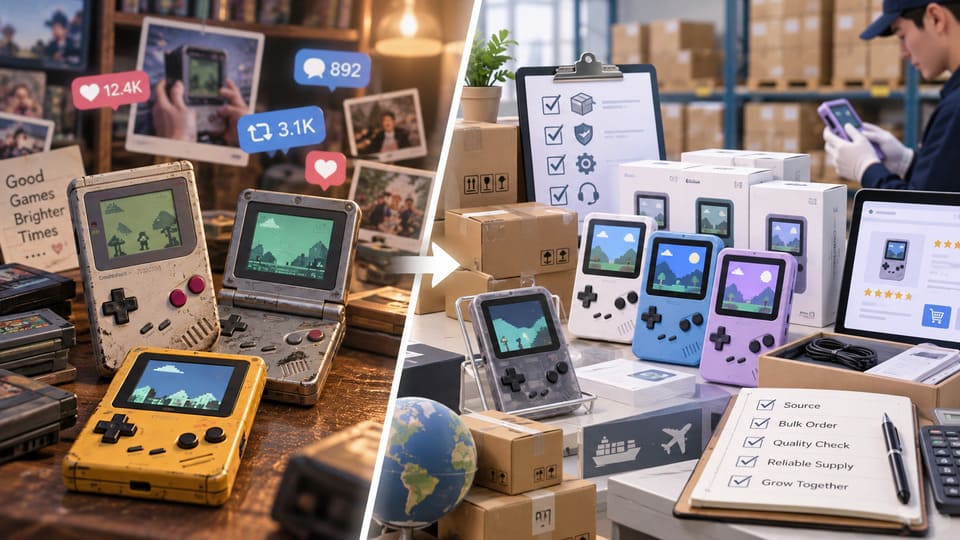
From my supplier-side conversations with overseas buyers, I see one clear pattern: people are not only watching old devices get repaired. They are showing interest in portable nostalgic gaming3. That is useful, but buyers still need a practical SKU strategy.
Do Old Handhelds Going Viral Mean Buyers Should Source Refurbished Devices?
When old handhelds appear everywhere on short videos, it is easy to think refurbished units are the next hot product. I understand the temptation. But attention and supply are different problems, and B2B buyers need both demand and repeatable inventory.
No, viral old handhelds do not automatically mean buyers should source refurbished devices. Restoration videos create interest, but refurbished vintage supply is usually limited, inconsistent, and harder to standardize4. B2B buyers usually need scalable retro handheld SKUs with predictable cost, quality control, packaging, and shipping support5.
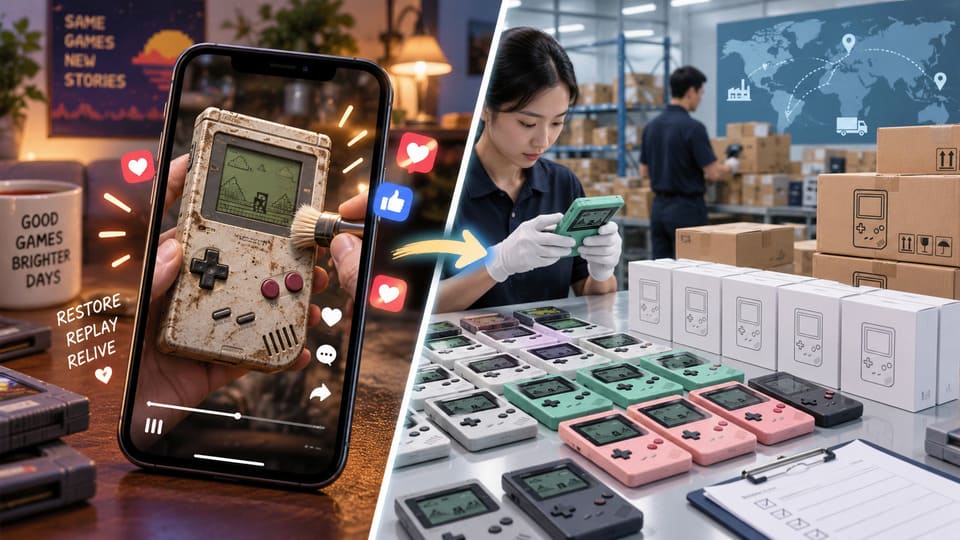
From a supplier’s product-line perspective, I separate the trend from the supply model.
Trend vs. wholesale reality
| Buyer sees online | Buyer must verify before purchase |
|---|---|
| Restored old handheld looks popular | Can I buy stable quantity every month? |
| Comments show nostalgia | What price band will my market accept? |
| Screen upgrade looks attractive | Is screen quality consistent by batch? |
| Repair content gets views | What is the return and warranty risk? |
I often tell buyers that what players spend their own money upgrading is a real consumer demand vote6. If consumers pay for better screens, buttons, batteries, or shells, that tells us what they value.
But that does not mean every buyer should sell restored old units. Refurbished devices can involve aging parts, uneven cosmetic condition, unclear sourcing, and higher after-sales pressure7. Newly manufactured retro handheld consoles are easier to evaluate as commercial products because buyers can compare:
- Screen size and display quality
- Button feel and control layout
- Battery capacity and charging method
- System stability
- Packaging strength
- MOQ and repeat supply
- Private-label options
- Shipping and replacement support
For importers and Amazon sellers, consistency matters more than viral charm.
How Should Buyers Read Old Handhelds as a Demand Signal?
The danger is treating “viral” as the same thing as “profitable.” I have seen buyers get excited by a trend, then realize too late that price, reviews, and return rates decide the real result8. Viral content is useful, but only after careful product selection.
Buyers should read old handhelds as proof of renewed interest in nostalgic portable gaming. The next step is not to copy the video product. The next step is to test modern retro handheld consoles by price band, build quality, controls, battery life, packaging, and buyer feedback.
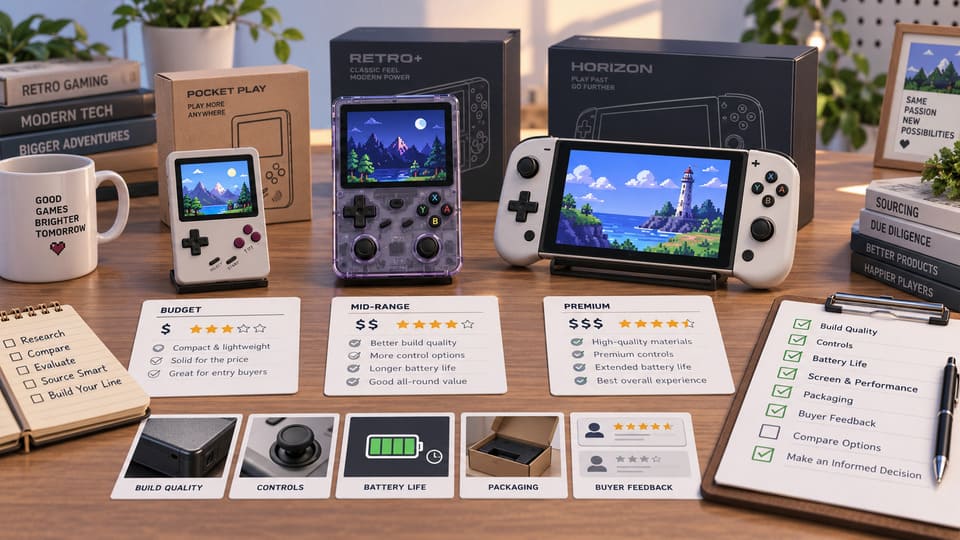
A product can be cheap at purchase and expensive after sale. I see this often in sourcing discussions. A low unit price looks attractive, but it can create hidden costs if customers complain.
Hidden costs buyers should calculate
- Returns: A weak battery or unstable system can erase margin.9
- Bad reviews: E-commerce sellers may lose ranking and conversion.
- Slow inventory: A trendy-looking item may not match the local price band.
- Support time: Confusing menus or poor packaging can increase messages.
- Replacement cost: Faulty accessories or screens create extra shipment pressure.
A simple product evaluation table helps:
| Evaluation point | Why it matters |
|---|---|
| Price band | Different markets accept different retail prices |
| Screen | Buyers notice brightness, viewing angle, and scratches |
| Controls | Poor buttons create fast complaints |
| Battery | Weak battery hurts user experience |
| Firmware/system | Stability affects returns |
| Packaging | Important for retail shelves and online delivery |
| Supplier response | After-sales handling protects your margin |
I do not suggest that buyers ignore trends. I suggest that they translate trends into testable buying decisions.
What Is a Low-Risk Old Handhelds Product-Line Strategy?
Many buyers ask if they should “go all in” when old handhelds become popular online. My answer is usually no. A better plan is to start small, read the market, and then expand into a balanced retro gaming product mix.
A low-risk strategy is to begin with a small trial order of stable retro handheld SKUs, measure sell-through and customer feedback10, then expand into several price levels. Buyers should avoid betting everything on one viral-looking product and should build a balanced catalog for different customer segments11.
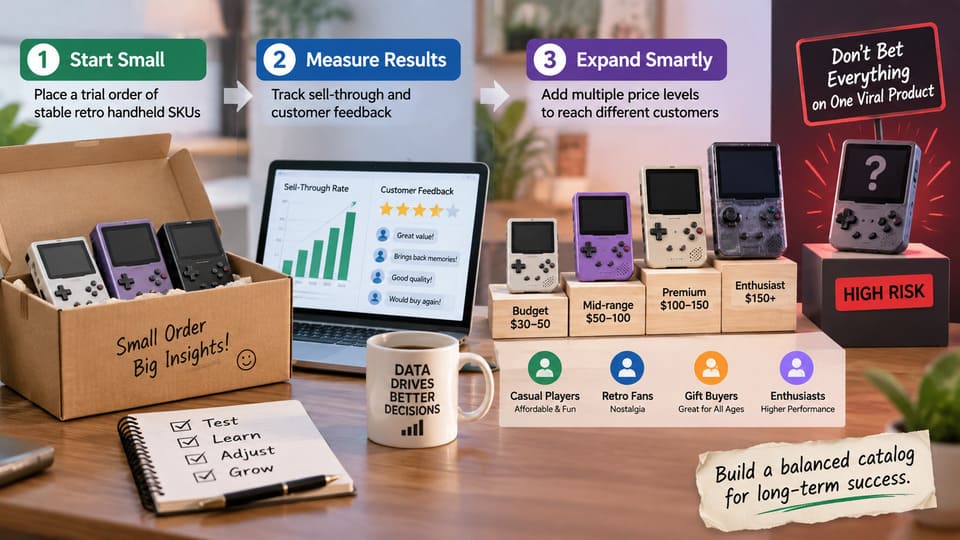
I like a three-step approach because it keeps emotion out of purchasing.
1. Start with a trial order
A trial order helps buyers check the real market response. I usually see buyers test:
- Entry-level handhelds for price-sensitive markets
- Mid-range models for online stores
- Larger-screen devices for gift channels
- TV game sticks as add-on SKUs
2. Track practical feedback
Buyers should track more than sales volume. They should also monitor:
- Return reasons
- Review keywords
- Packaging damage
- Battery complaints
- Customer questions
- Repeat purchase interest
3. Build a balanced SKU mix
A healthy retro gaming line should not depend on one item. I prefer a mix of handheld retro game consoles, HDMI TV game sticks, and plug-and-play home consoles, depending on the buyer’s channel.
For OEM/ODM or private-label projects, buyers should also verify logo placement, packaging files, manuals, carton strength, and compliance documents required in their market. Any certification or legal requirement should be checked with qualified local professionals before bulk ordering.
Frequently Asked Questions
Are restored old handhelds good wholesale products?
They can attract attention, but they are difficult to scale. Refurbished supply is often inconsistent. For most B2B buyers, newly produced retro handheld consoles are easier to test, repeat, customize, and support after sale.
Does viral content guarantee retro handheld sales?
No. Viral content shows interest, not guaranteed sales. Buyers still need to test pricing, product quality, packaging, shipping cost, reviews, and after-sales risk in their own sales channel.
What should I test in a first retro handheld order?
I would test screen quality, buttons, battery life, system stability, packaging strength, accessory quality, and customer feedback. I would also compare sell-through speed across two or three price levels.
Should Amazon sellers choose the cheapest retro handheld?
Not always. The cheapest product can become expensive if it causes returns, negative reviews, or account pressure. Amazon sellers should balance landed cost with quality stability and after-sales support.
Conclusion
Old handhelds are useful because they show renewed interest in nostalgic gaming, but buyers should not confuse viral restoration content with a stable wholesale model. I would treat old handhelds as a demand signal, then test newly produced retro handheld consoles through small trial orders, practical QC checks, and balanced SKU planning. If you are evaluating retro gaming products for wholesale, import, or private label, KLF can help you compare suitable models and plan a lower-risk trial order.
"Going viral: How social and personal motivations drive ... - PMC", https://pmc.ncbi.nlm.nih.gov/articles/PMC12626328/. Consumer-behavior research on the intention–behavior gap indicates that favorable attention or expressed interest does not necessarily result in purchasing behavior; this evidence is contextual rather than a direct measurement of retro handheld demand. Evidence role: mechanism; source type: paper. Supports: Research on consumer behavior and social media engagement should support that attention, likes, or expressed interest are imperfect predictors of actual purchases.. Scope note: Contextual support; it does not specifically study refurbished or retro handheld consoles. ↩
"Using social media data in demand forecasting: the case of ...", https://commons.stmarytx.edu/theses/6/. Studies of digital trace data in demand forecasting describe search and social-media signals as potentially useful indicators while emphasizing their limits for operational forecasts; this supports treating restoration content as contextual demand evidence rather than a procurement plan. Evidence role: general_support; source type: paper. Supports: A source should show that digital attention data can be useful as an early demand indicator but has limitations for forecasting and operational planning.. Scope note: Contextual support; it does not validate any specific retro gaming sourcing strategy. ↩
"Video Game Nostalgia and the Success of Retro Gaming", https://researchrepository.wvu.edu/cgi/viewcontent.cgi?article=2237&context=faculty_publications. Research on video game nostalgia identifies nostalgia as a meaningful factor in how players value older games and gaming experiences; this provides contextual support for interpreting old handheld content as interest in nostalgic gaming. Evidence role: general_support; source type: paper. Supports: Academic research should support that nostalgia is a recognized motivator in video game interest, play, or purchasing behavior.. Scope note: Contextual support; it does not quantify demand for portable retro handheld products. ↩
"(PDF) Closed loop Supply Chain with Remanufacturing", https://www.academia.edu/1494794/Closed_loop_Supply_Chain_with_Remanufacturing_a_literature_review. Remanufacturing literature describes uncertainty in the availability, timing, and quality of returned products as a recurring operational challenge, supporting the claim that refurbished vintage supply can be difficult to standardize. Evidence role: mechanism; source type: paper. Supports: Research on remanufacturing or closed-loop supply chains should support that used-product availability, timing, and condition create uncertainty and standardization challenges.. Scope note: Contextual support; most remanufacturing studies discuss used products broadly rather than vintage gaming handhelds specifically. ↩
"Supplier selection and order allocation: a literature review - PMC", https://pmc.ncbi.nlm.nih.gov/articles/PMC8127846/. Supplier-selection studies consistently identify cost, quality, delivery reliability, and service capability among core procurement criteria, supporting the article’s emphasis on predictable commercial and operational support. Evidence role: expert_consensus; source type: paper. Supports: Supplier-selection research should support that cost, quality, delivery reliability, and service capability are common evaluation criteria in procurement.. Scope note: Contextual support; the evidence concerns supplier selection generally, not retro handheld consoles alone. ↩
"How Are Preferences Revealed? - PMC - NIH", https://pmc.ncbi.nlm.nih.gov/articles/PMC3993927/. Revealed-preference and willingness-to-pay research treats observed purchasing choices as evidence of the attributes consumers value, providing contextual support for interpreting paid upgrades as a signal of demand for improved components. Evidence role: mechanism; source type: paper. Supports: A source should support that actual spending behavior can reveal consumer preferences for product attributes.. Scope note: Contextual support; it does not prove that upgrade spending in hobbyist communities predicts wholesale sell-through. ↩
"Key drivers and priorities of consumer decisions for ... - PMC", https://pmc.ncbi.nlm.nih.gov/articles/PMC11696784/. Studies of refurbished electronics and battery aging show that used devices may vary in condition and that aging components can affect reliability, supporting the article’s concern about quality and after-sales risk. Evidence role: general_support; source type: paper. Supports: Research should support that used or refurbished electronics can vary in condition and that aging components such as batteries affect reliability.. Scope note: Contextual support; the evidence may address consumer electronics broadly rather than vintage handheld game systems specifically. ↩
"The impact of online reviews in the presence of customer returns", https://pmc.ncbi.nlm.nih.gov/articles/PMC7501828/. E-commerce research identifies price, customer reviews, and product returns as important factors affecting purchasing behavior and retailer profitability, supporting the article’s broader point that trend attention alone is insufficient. Evidence role: general_support; source type: paper. Supports: A source should support that pricing, reviews, and returns are important determinants of online retail performance.. Scope note: Contextual support; the relative importance of these factors varies by platform, category, and market. ↩
"Allocating Between Remarketing and Refurbishing for ...", https://sites.insead.edu/facultyresearch/research/file.cfm?fid=59241. Research on product returns and reverse logistics finds that returns generate handling, transport, refurbishment, and resale costs that reduce retailer profitability, supporting the claim that quality failures can erode margin. Evidence role: mechanism; source type: paper. Supports: Research should support that product returns and reverse-logistics processes impose costs that can reduce retailer profitability.. Scope note: Contextual support; it does not calculate margins for retro handheld consoles. ↩
"Navigating new product development: Uncovering factors and ...", https://pmc.ncbi.nlm.nih.gov/articles/PMC10788447/. Research on entrepreneurial experimentation and new-product development supports using limited market tests and customer feedback to reduce uncertainty before larger commitments, providing contextual support for small trial orders. Evidence role: mechanism; source type: paper. Supports: Research on experimentation or new-product development should support using small tests and customer feedback to reduce uncertainty before scaling.. Scope note: Contextual support; it does not specify optimal order quantities for retro handheld products. ↩
"The evolving role of hit and niche products in brick-and-mortar ...", https://pmc.ncbi.nlm.nih.gov/articles/PMC7387359/. Retail assortment and marketing research shows that product variety and assortment structure are used to address heterogeneous consumer preferences, supporting the rationale for a catalog aimed at multiple customer segments. Evidence role: general_support; source type: paper. Supports: Marketing or retail research should support that assortment planning accounts for heterogeneous customer preferences and segments.. Scope note: Contextual support; it does not prove that a specific retro gaming assortment will outperform a single-SKU strategy. ↩