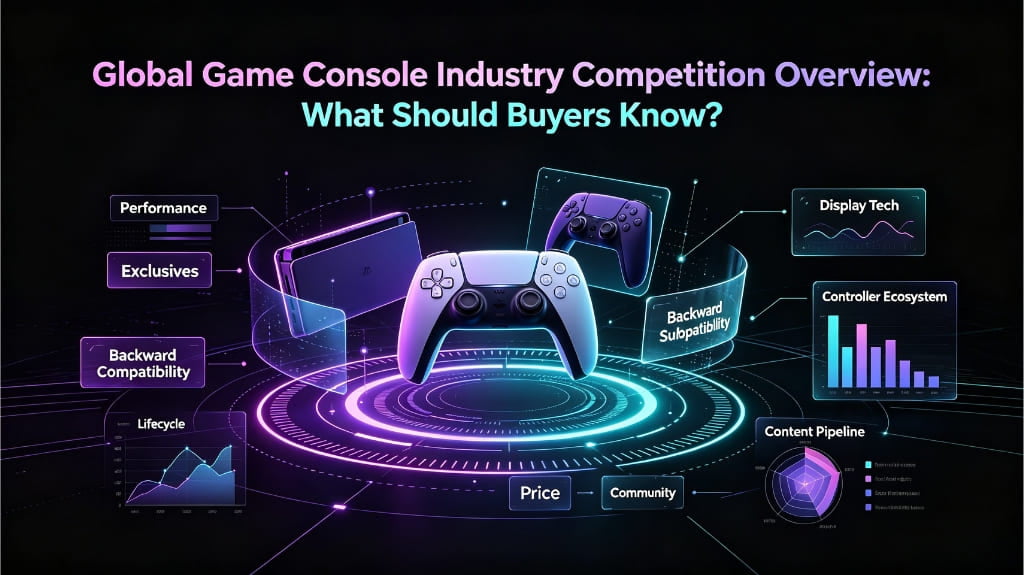

Global game console industry competition is no longer a simple battle between famous console brands. Many buyers still treat the market as one category, then struggle with thin margins, unstable suppliers, and high return rates. I believe the better solution is to understand the three parallel markets and source products based on profit model, product quality, and supply chain strength.
Global game console industry competition now includes three major tracks: branded home consoles, retro handheld game consoles, and modern multifunction handheld consoles1. Branded consoles rely on closed ecosystems and volume sales2, while retro handhelds offer more open customization and higher margins. Modern handhelds are growing fast3 because they combine portability, performance, and flexible entertainment use.
I have seen many wholesalers lose money by chasing the cheapest model only. However, the market is changing. Buyers now care more about system stability, Hall joysticks, Type-C charging, WiFi features, packaging, and long-term supply reliability.
What Does the Current Landscape of the Global Game Console Industry Competition Look Like?
Many buyers feel confused because the game console market looks crowded from the outside. This confusion becomes expensive when a buyer compares a branded console, a retro handheld, and a multifunction handheld as if they were the same product. I see the real answer in market segmentation.
Global game console industry competition currently runs across three parallel markets: branded consoles, retro handheld consoles, and modern multifunction handhelds. Each market has a different ecosystem, buyer group, margin structure, and supply chain model. Smart distributors choose the right segment instead of competing only on price.
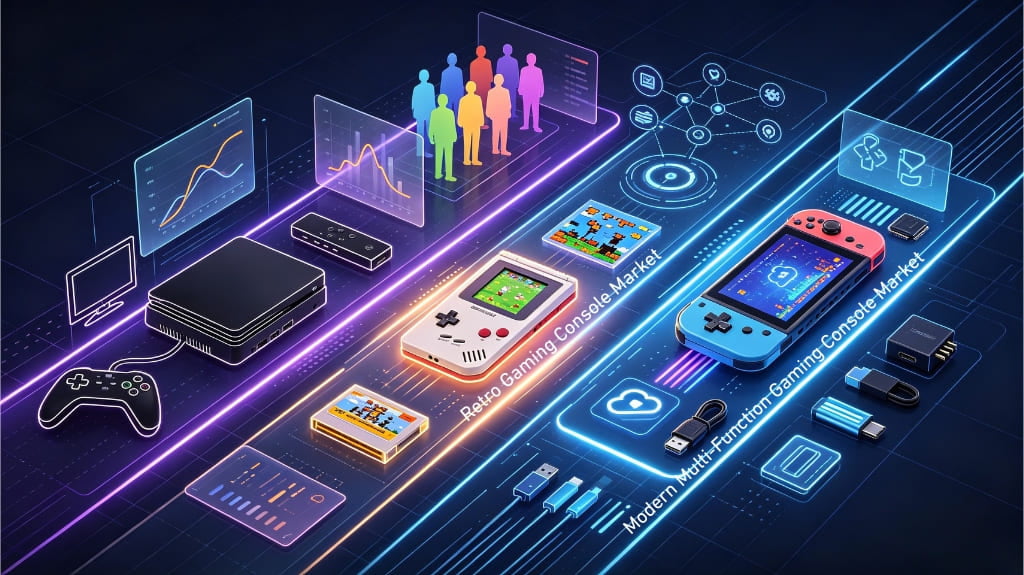
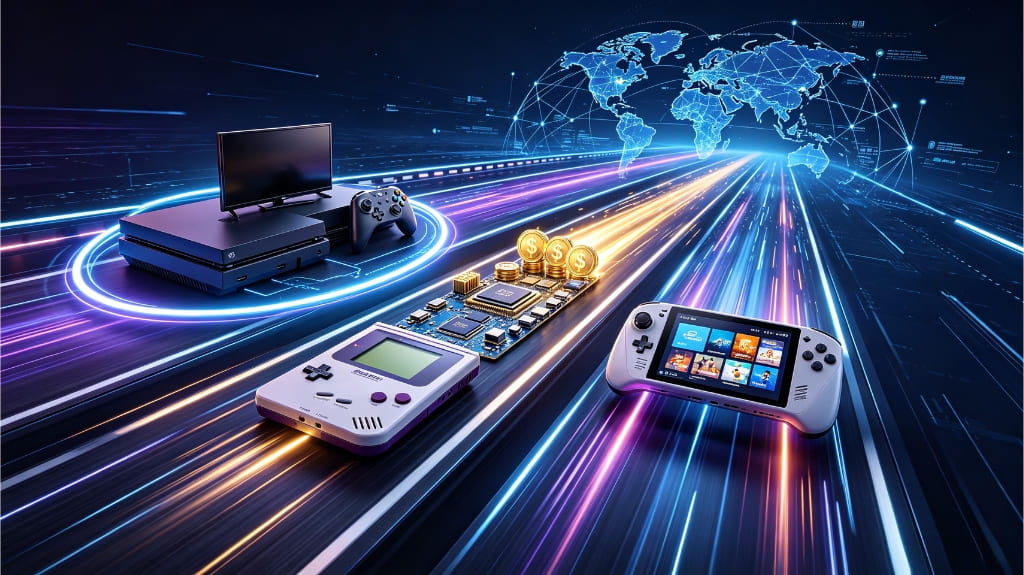
The current market is not one straight road. I prefer to view it as three lanes moving at different speeds. Each lane has its own rules, risks, and opportunities.
Three Parallel Markets, Not One Single Track
| Market Segment | Ecosystem Type | Typical Buyers | Margin Level | Main Competition Factor |
|---|---|---|---|---|
| Branded home consoles | Closed ecosystem | Large retailers, official channels | Low to medium | Brand power and game library |
| Retro handheld consoles | Open ecosystem | Wholesalers, e-commerce sellers, distributors | Medium to high | Design, quality, games, customization |
| Modern multifunction handhelds | Mixed ecosystem | Gamers, tech sellers, premium stores | Growing | Performance, system experience, hardware |
1. Branded Consoles: Strong Demand, Thin Wholesale Margin
Branded consoles still dominate consumer awareness. I do not deny their power. Products from major international brands have strong game ecosystems, exclusive titles, and loyal users4.
However, from a wholesaler’s point of view, this segment is difficult. The ecosystem is closed. Pricing is transparent. Official channels control supply. Many wholesalers can only make money through large volume and fast turnover.
That means the business model is not very flexible. A distributor often faces:
- Lower profit margins
- High capital pressure
- Strict channel competition
- Limited product differentiation
- Less control over packaging or branding
This model can work for large companies. But for many medium wholesalers and e-commerce sellers, it can feel like running faster just to keep the same profit.
2. Retro Handheld Consoles: Open Ecosystem, Better Differentiation
Retro handheld game consoles are different. I see this as one of the most flexible segments in the global game console industry competition. The ecosystem is more open. Buyers can customize shell color, logo, packaging, user interface, storage, game list, and accessories.
This gives wholesalers and online sellers more room to build their own identity. For example, an Amazon seller can use:
- A transparent shell
- Retail-ready gift packaging
- A larger screen
- Hall joysticks
- A custom boot logo
- A curated retro game library
These details help the product look different from a basic low-cost console.
3. Modern Multifunction Handhelds: Fast-Growing Mixed Ecosystem
Modern handheld gaming devices are growing quickly because they sit between retro gaming and portable entertainment. Some models support cloud gaming, Android apps, WiFi multiplayer, media playback, and higher-performance emulation.
This segment has a mixed ecosystem. It is not as closed as branded consoles, but it is not as simple as early retro handhelds. Buyers need better hardware, stronger software development, and more stable quality control.
I see this category attracting:
- Premium e-commerce sellers
- Gaming accessory distributors
- Young consumer electronics brands
- Retailers looking for higher-ticket products
The profit can be attractive, but the technical requirements are also higher. If the system crashes, freezes, or lags, customers return the product quickly. So I always remind buyers that stable performance matters more than a long feature list.
Which Key Competitors and Strategies Define Global Game Console Industry Competition?
Many suppliers look similar on Alibaba or trade websites. This creates a problem for buyers because price becomes the easiest comparison point. But I have learned that the cheapest factory is not always the lowest-cost partner after returns, delays, and complaints.
Global game console industry competition is shaped by brand owners, large factories, small low-price factories, and flexible OEM/ODM manufacturers. The strongest competitors do not only sell hardware. They combine product planning, stable supply, quality control, customization, and market timing.
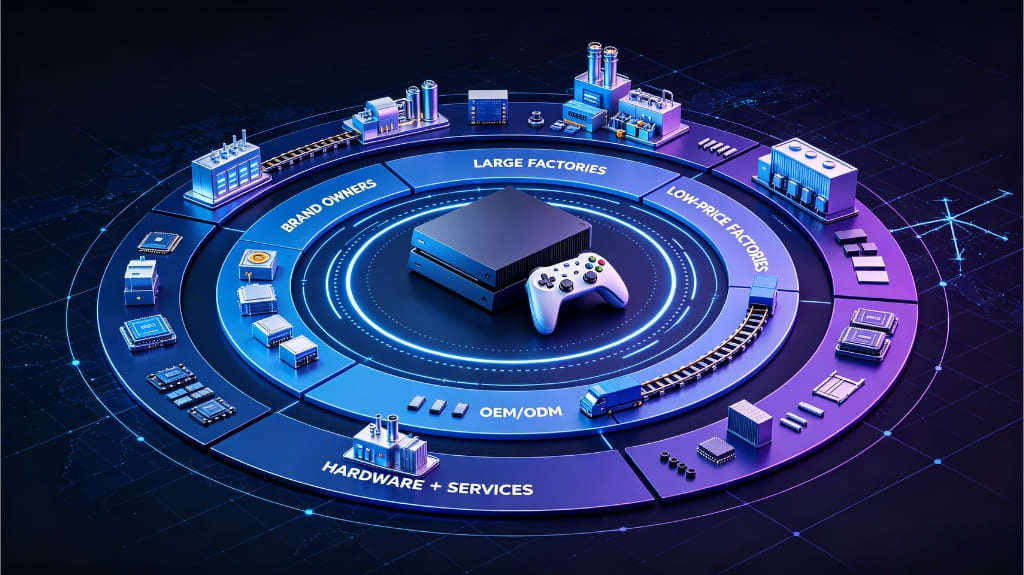
From a manufacturing perspective, I divide competitors into four groups. Each group competes in a different way. Once buyers understand these groups, supplier selection becomes much easier.
Competitor Type 1: Global Brand Console Companies
Large console brands compete through ecosystems. They do not only sell a device. They sell games, online services, digital stores, subscriptions, and exclusive content.
Their strategy includes:
- Closed hardware and software ecosystem
- Exclusive game titles
- Strong retail partnerships
- Global marketing campaigns
- Long product life cycles
- Subscription-based services
This model is powerful, but it does not fit every buyer. Most wholesalers cannot customize the product. They cannot create their own boot screen, packaging style, or private label. As a result, the buyer becomes a channel seller instead of a product owner.
Competitor Type 2: Low-Cost Retro Console Factories
Many small factories still compete with first-generation thinking. They believe the market only wants cheap products that can run many emulator formats. I understand why this happened. From 2015 to 2019, many buyers only asked simple questions:
- How many games are included?
- How many formats can it run?
- What is the lowest price?
- Can it ship quickly?
At that time, many products had small screens, rough plastic shells, weak batteries, and basic buttons. The user expectation was lower.
But the market has moved on. Low-quality products now create serious business risks:
| Problem | Short-Term Saving | Long-Term Cost |
|---|---|---|
| Cheap joystick | Lower unit cost | Higher drift complaints |
| Micro-USB port | Slight cost saving | Lower customer acceptance |
| Poor battery | Lower BOM cost | More returns and bad reviews |
| Unstable system | Faster launch | Refunds and negative ratings |
| Weak QC | Lower labor cost | Higher defect rate |
I have seen buyers choose a low-price product and later discover that return costs destroy the profit. This is why many professional wholesalers now focus on total cost, not just factory price.
Competitor Type 3: Screen and Hardware Upgrade Factories
From 2019 to 2023, the second generation of retro handheld consoles entered a screen race. The market moved from 2.4-inch displays to 3.5-inch, then 5-inch and larger screens. Many factories competed by launching bigger-screen products as fast as possible.
This strategy worked for a period. A bigger screen was easy for retail customers to understand. Product photos looked better. Store demonstrations looked stronger. But screen size alone is no longer enough.
A bigger display can also create new problems:
- Higher power consumption
- More heat
- Shorter battery life
- Higher panel defect risk
- More pressure on chipset performance
So I believe hardware upgrades must be balanced. A 5-inch display is attractive, but only when the battery, chipset, system, and shell design support it well.
Competitor Type 4: Stable OEM/ODM Manufacturers
The strongest factories today compete through overall product experience. They focus on:
- System stability
- Reliable components
- Better industrial design
- Flexible customization
- Supply chain control
- Consistent quality inspection
This is where Shenzhen Kalefu Electronics positions itself. We manufacture retro game consoles, handheld gaming consoles, TV game consoles, and OEM/ODM gaming devices. I see our role as helping buyers reduce sourcing risk while building more competitive products.
For example, a brand owner may need:
- Custom shell color
- Logo printing
- Private packaging
- Custom UI
- Built-in game library customization
- Retail-ready packaging for Amazon or Shopify
- Small trial order before mass production
A factory that only copies products cannot support this well. A reliable OEM/ODM partner needs product planning, engineering support, production capacity, and export experience.
Which Emerging Trends Are Shaping the Global Game Console Industry Competition?
The market is moving fast, and buyers can easily chase every new feature. That creates another problem. If a factory blindly adds functions, cost rises and stability may fall. I believe manufacturers must know which upgrades truly affect buying decisions.
Global game console industry competition is now shaped by practical upgrades such as Hall joysticks, Type-C charging, WiFi multiplayer, better screens, stable systems, RGB lighting, and customized appearance. Some features are now essential, while others work best when they support clear retail positioning.
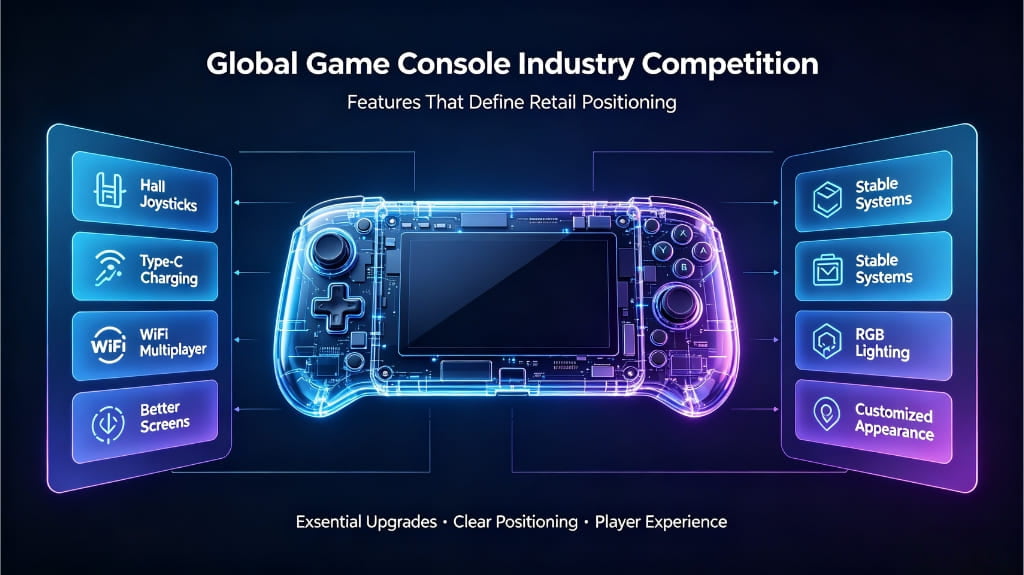
I usually separate trends into two groups: must-have upgrades and differentiation upgrades. This helps buyers avoid overpaying for gimmicks while still building a product that sells.
Must-Have Trend 1: Hall Joysticks Are Becoming Standard
Hall joysticks used to be an optional premium feature. Now I see them becoming almost mandatory in mid-range and higher-quality handheld consoles.
Traditional joysticks can develop drift after repeated use.5 Once drift appears, customers complain quickly because the product feels broken. For e-commerce sellers, joystick drift can cause:
- Higher return rates
- Negative reviews
- Customer service pressure
- Replacement costs
- Lower store ranking
Hall joystick technology uses magnetic sensing instead of traditional contact-based movement detection.6 The component cost is higher, but the long-term return rate is lower.
I often tell buyers: “The cheapest joystick is not cheap if it creates refunds.”
For wholesalers and Amazon sellers, Hall joysticks can be a strong selling point in product listings. The feature is easy to explain, and users understand the benefit.
Must-Have Trend 2: Type-C Charging Is Replacing Micro-USB
Micro-USB is disappearing from consumer electronics.7 End users increasingly reject old charging ports. Even if Micro-USB saves a small amount of cost, it makes the product feel outdated.
Type-C charging improves:
- User convenience
- Product appearance
- Retail acceptance
- Compatibility with modern chargers8
- Perceived product value
For modern handheld game consoles, I now consider Type-C a basic requirement. A buyer who plans to sell in Europe, North America, or Southeast Asia should be careful with Micro-USB models because consumer expectations have changed.
Differentiation Trend 1: WiFi Multiplayer and Online Functions
WiFi used to look like a flashy feature. Now it has become a practical differentiation point, especially in retail demonstrations. A salesperson can show multiplayer connection or online update functions, and the product feels more modern immediately.
WiFi can support:
- Local multiplayer
- Online game updates
- Media or app functions on some systems
- Wireless file transfer
- Better in-store demonstration value
However, WiFi must be stable. If the connection is difficult, the feature becomes a complaint source. So I prefer fewer but better-tested wireless functions.
Differentiation Trend 2: RGB Lighting and Visual Design
RGB lighting is controversial. Some buyers think it is unnecessary. Some gamers love it. My factory-side view is practical: retail data often shows that products with lighting sell faster when the target audience is young or gift-focused.
RGB works best when combined with:
- Transparent shells
- Modern packaging
- Gaming-style product photos
- Short demo videos
- Holiday gift positioning
But RGB should not harm battery life or system stability. A good design uses lighting as an emotional selling point, not as a replacement for quality.
Differentiation Trend 3: Custom Shells, Colors, and Co-Branded Designs
Appearance differentiation is becoming more important. Many sellers now ask for:
- Transparent shell designs
- Limited edition colors
- Custom logo printing
- Co-branded packaging
- Special gift bundles
- Custom boot animation
This trend is especially important for e-commerce sellers. When many listings use similar product specifications, the product photo becomes the first battlefield. A unique shell color or packaging design can improve click-through rate.
Product Generations: How the Market Has Evolved
I see the retro handheld market in three clear generations:
| Generation | Period | Main Competition | Product Features |
|---|---|---|---|
| First generation | 2015–2019 | Emulator quantity | Small screen, rough build, basic performance |
| Second generation | 2019–2023 | Bigger screen | 2.4-inch to 3.5-inch to 5-inch displays |
| Third generation | 2023–now | Overall experience | Better screen, joystick, battery, shell, system stability |
The third generation is the most important for serious buyers. The market no longer rewards only “more games” or “bigger screen.” Customers want the product to feel stable, comfortable, and modern.
What Opportunities and Challenges for Manufacturers Should Buyers Understand?
A buyer may think product design is the biggest challenge, but I see supply chain execution as the real battlefield. A product can be copied quickly. However, mold development speed, chip purchasing cost, QC systems, and inventory strategy are much harder to copy.
Manufacturers have strong opportunities in retro handhelds, OEM branding, differentiated designs, and modern multifunction consoles. The main challenges are component cost, quality control, production planning, inventory risk, and system stability. Buyers should choose factories with proven supply chain efficiency, not just attractive sample photos.
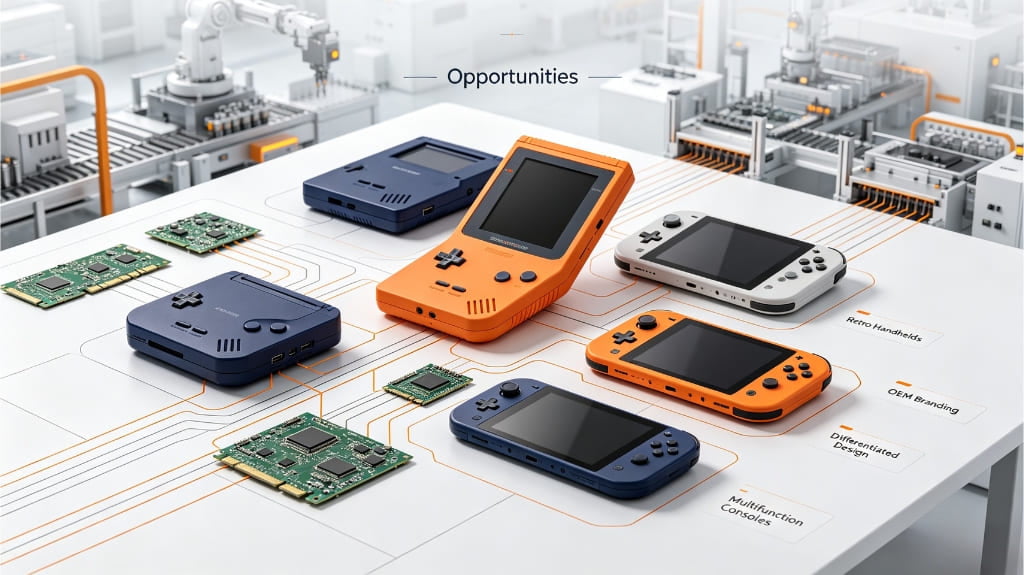
I believe the next 12 months will reward factories that can do two things at the same time: make stable products and create visible differentiation. This sounds simple, but it requires strong management behind the scenes.
Opportunity 1: OEM/ODM Demand Is Growing
More wholesalers and distributors want private label products. They do not want to sell the exact same model as every competitor. This creates a strong opportunity for manufacturers with OEM/ODM ability.
Common customization requests include:
- Custom logo
- Shell color customization
- Retail packaging design
- Private label manuals
- Custom boot screen
- User interface adjustment
- Built-in game library customization
- Bundle kits with cables, bags, or controllers
For brand owners, OEM/ODM service helps create long-term value. A private label product can build customer loyalty and reduce direct price comparison.
At Kalefu, we support customers from concept to production. We can help with product design, hardware configuration, assembly, packaging, and testing. This matters because many buyers do not only need a supplier. They need a manufacturing partner.
Challenge 1: Mold Development Speed and Cost
Mold development affects launch timing. A factory with its own mold resources can often move faster than a factory that depends fully on outside mold suppliers.
From my experience, the difference can be significant:
| Mold Resource Type | Lead Time Impact | Cost Impact | Best For |
|---|---|---|---|
| In-house or close mold partner | Faster by 2–3 weeks | More controlled | New product launch |
| External mold supplier | Slower | Often 15–20% higher total cost | Basic modification |
| Shared public mold | Fastest | Lowest | Low differentiation products |
If a buyer wants a unique shell design, mold planning must start early. Waiting until peak season usually creates delays.
Challenge 2: Chip Procurement Creates Price Gaps
Mainstream chips such as RK3562 and RK3399 are common in many handheld gaming devices. However, chip purchasing price can vary widely by order volume, timing, and supplier relationship.
A large factory may receive a much better price than a small factory. In some cases, the chip purchasing price difference between large and small orders can reach around 30%. This directly affects final product cost.
But chip selection is not only about price. A factory must also consider:
- Emulator performance
- Heat control
- Battery consumption
- System compatibility
- Firmware support
- Long-term availability
A cheap chip can create hidden costs if it causes lag, crashes, or poor game compatibility.
Challenge 3: Quality Control Determines Real Profit
Small factories often rely heavily on manual visual inspection. Larger and more professional factories use more systematic testing, including function checks, aging tests, button tests, charging tests, display checks, and system stability testing.
The yield difference can be around 5–10% between weak and strong QC systems. But the return cost difference can be much larger, sometimes 2–3 times higher for poorly controlled products.
A serious QC process should check:
- Screen brightness and dead pixels
- Button response
- Joystick calibration
- Charging stability
- Battery performance
- Speaker output
- System boot speed
- Game loading stability
- WiFi connection, if included
- Packaging completeness
I always see QC as profit protection. A product that looks cheap at the factory can become expensive after refunds, bad reviews, and lost customers.
Challenge 4: Inventory Strategy Can Decide Peak Season Success
Game console demand is seasonal. Q4 is usually the strongest period because of Christmas, Black Friday, New Year promotions, and gift demand.9 A good factory must prepare materials early.
For peak season, I usually recommend preparing key components around three months in advance, especially screens, chips, batteries, shells, and packaging materials.
Poor inventory management creates two opposite problems:
- Peak season stockout: The buyer misses the best sales window.
- Off-season overstock: The factory or buyer holds too much inventory and cash gets locked.
Many small factories fail during Q4 not because they lack orders, but because they cannot get materials fast enough. This is why I say supply chain efficiency cannot be copied easily.
Challenge 5: System Stability Is More Important Than Feature Quantity
Many products advertise long feature lists. But if the system crashes, freezes, or lags, users will not care about extra functions. I believe system stability is now one of the strongest competitive advantages in the global game console industry competition.
A stable handheld console should provide:
- Fast boot time
- Smooth menu navigation
- Consistent emulator performance
- No frequent freezing
- Reliable save function
- Stable charging and battery display
- Clean user interface
For buyers, this means sample testing should go beyond appearance. I recommend testing a sample for several days, not just five minutes. Play different games, charge it repeatedly, test buttons, and check heat after long use.
Frequently Asked Questions
What are the main segments in the game console market?
The game console market has three major segments: branded home consoles, retro handheld consoles, and modern multifunction handhelds. Branded consoles use closed ecosystems, retro handhelds offer open customization, and modern handhelds combine gaming, media, wireless functions, and stronger hardware performance.
Why are retro handheld game consoles attractive for wholesalers?
Retro handheld game consoles are attractive because they offer better customization and stronger profit potential than many branded console products. Wholesalers can customize packaging, logo, shell color, game library, and accessories, which helps reduce direct price competition and build differentiated product lines.
Are Hall joysticks worth the higher cost?
Yes, Hall joysticks are often worth the higher cost because they reduce joystick drift problems. Traditional joystick drift can lead to returns, bad reviews, and customer complaints. For e-commerce sellers and distributors, lower return rates can create better total profit.
Why is Type-C charging important for handheld game consoles?
Type-C charging is important because consumers now expect modern charging ports. Micro-USB makes a product feel outdated and less convenient. Type-C improves user experience, retail appeal, and compatibility with current chargers, especially in Europe, North America, and other mature markets.
How should buyers choose a reliable game console manufacturer?
Buyers should evaluate production capacity, QC process, OEM/ODM ability, component sourcing, delivery history, and sample stability. A reliable manufacturer should provide consistent quality, clear communication, flexible customization, and strong supply chain planning for both peak season and regular replenishment.
Conclusion
Global game console industry competition is shifting from simple price competition to product experience, customization, and supply chain efficiency. I see the strongest opportunities in retro handheld consoles, modern multifunction handhelds, and OEM/ODM private label projects. Buyers should focus on stable systems, Hall joysticks, Type-C charging, quality control, and reliable delivery. If you want to develop competitive gaming console products with factory pricing and flexible customization, contact Shenzhen Kalefu Electronics Co., Ltd for OEM/ODM support and worldwide supply.
"Video game console - Wikipedia", https://en.wikipedia.org/wiki/Video_game_console. The cited source classifies the console market into home and handheld device categories and provides contextual support for treating branded home consoles and handheld devices as separate competitive segments. Evidence role: general_support; source type: institution. Supports: A neutral industry or institutional source should support the distinction between home consoles and handheld gaming devices, and ideally discuss newer portable gaming categories.. Scope note: Most neutral sources may not use the article's exact three-track terminology, so the evidence would support the segmentation context rather than prove this precise framework. ↩
"Razor-and-blades model - Wikipedia", https://en.wikipedia.org/wiki/Razor-and-blades_model. The cited study explains that major console platforms operate as controlled hardware-software ecosystems in which revenue depends on installed base scale, software licensing, and platform services. Evidence role: mechanism; source type: paper. Supports: A scholarly source should explain how console platforms use controlled hardware/software ecosystems, game licensing, digital stores, and scale economics.. Scope note: Such evidence would explain the business mechanism but may not directly quantify wholesale margins for every branded console channel. ↩
"Video games in India", https://en.wikipedia.org/wiki/Video_games_in_India. The cited market analysis reports recent or forecast growth in portable handheld gaming devices, supporting the claim that the category is expanding rapidly. Evidence role: statistic; source type: institution. Supports: A market analysis from a neutral institution should provide growth estimates, shipment trends, or revenue forecasts for handheld gaming devices.. Scope note: Market reports may define the category differently, sometimes including handheld PCs, cloud-gaming devices, or portable consoles rather than only multifunction handhelds. ↩
"Console war", https://en.wikipedia.org/wiki/Console_war. The cited research describes exclusive software, network effects, and platform ecosystems as important factors in video game console competition and consumer retention. Evidence role: expert_consensus; source type: paper. Supports: A scholarly or research source should support the role of exclusive games, platform ecosystems, and user lock-in in console competition.. Scope note: The source may discuss established console platforms generally rather than the specific wholesale sourcing context of the article. ↩
"Potentiometer", https://en.wikipedia.org/wiki/Potentiometer. The cited technical source describes analog stick drift as a failure mode associated with wear, contamination, or degradation in contact-based joystick sensing components. Evidence role: mechanism; source type: research. Supports: A technical source should explain that analog joystick drift can arise from wear, contamination, or degradation in potentiometer-based sensing mechanisms.. Scope note: The source may discuss game controllers broadly rather than retro handheld consoles specifically. ↩
"Hall effect", https://en.wikipedia.org/wiki/Hall_effect. The cited engineering source explains that Hall-effect sensors detect magnetic fields and enable contactless position measurement, supporting the description of Hall joysticks as magnetic rather than contact-based devices. Evidence role: mechanism; source type: education. Supports: An engineering or university source should explain that Hall-effect sensors measure magnetic fields and can be used for contactless position sensing.. ↩
"Common external power supply", https://en.wikipedia.org/wiki/Common_external_power_supply. The cited source documents the regulatory or standards-based move toward USB-C charging for consumer electronics, providing context for the decline of Micro-USB in newer devices. Evidence role: historical_context; source type: government. Supports: A government or standards source should show that USB-C has become the required or preferred charging interface for many consumer electronics.. Scope note: A regional regulation, such as the European Union common charger rule, supports the trend in that market but does not by itself prove global disappearance. ↩
"USB-C - Wikipedia", https://en.wikipedia.org/wiki/USB-C. The cited standards source defines USB-C as a common connector and charging interface designed to support interoperability across compatible consumer electronic devices and chargers. Evidence role: definition; source type: institution. Supports: A standards or institutional source should explain USB-C as a common connector standard intended to improve interoperability across devices and chargers.. Scope note: Compatibility still depends on device power requirements, charger capabilities, and cable specifications. ↩
"Monthly Retail Trade - Sales Report - Census Bureau", https://www.census.gov/retail/sales.html. The cited retail sales data show elevated fourth-quarter consumer purchasing during the holiday period, supporting the article's claim that console-related demand is seasonally concentrated around Q4. Evidence role: statistic; source type: government. Supports: A government retail dataset or neutral industry report should show seasonal increases in electronics, toys, or video game hardware sales during the holiday quarter.. Scope note: General retail or electronics data may support holiday seasonality contextually rather than isolate retro handheld console demand. ↩