


You place a bulk order for 5,000 retro gaming consoles. The shipment arrives late. Half the units have different button configurations than your sample. Your customers start returning defective products. Your sales season is ruined.
Global retailers choose Chinese retro gaming console manufacturers not just for lower prices, but because experienced suppliers have built systems that reduce three critical business risks: unpredictable delivery schedules, inconsistent product quality across batches, and limited ability to customize products for brand differentiation.
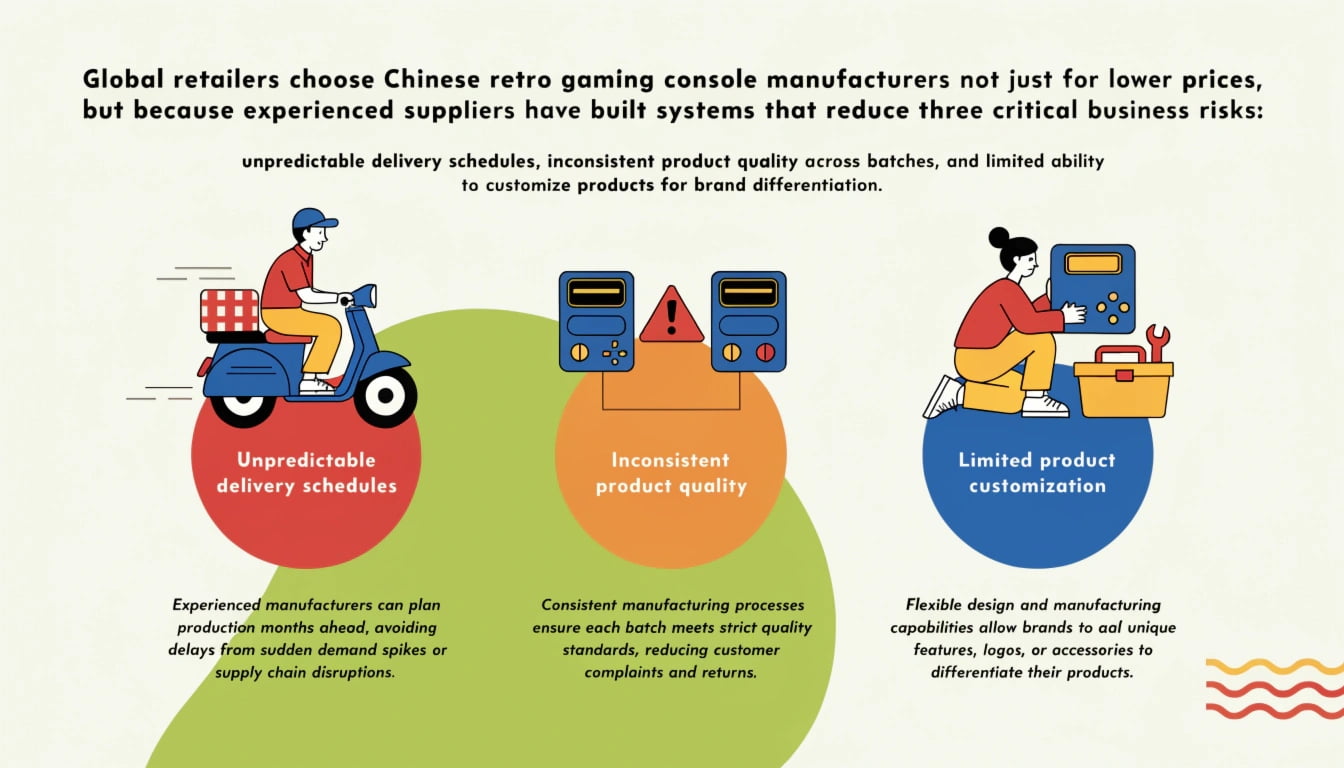
This choice reflects a shift in how international buyers evaluate Chinese suppliers. I have observed this pattern repeatedly when retailers first approach manufacturers in Shenzhen. The conversation always starts with three questions: Can you deliver on time? Will every batch match my quality standards? Can you help me create a product that stands out?
What Makes Retailers Hesitate Before Their First Order?
When retailers begin searching for Chinese gaming console suppliers, they carry three specific concerns. These worries shape every initial email and video call I see happening between buyers and factories.
Retailers worry most about delivery uncertainty, assumption that Chinese factories only assemble existing designs, and fear that product quality will vary unpredictably between production runs.
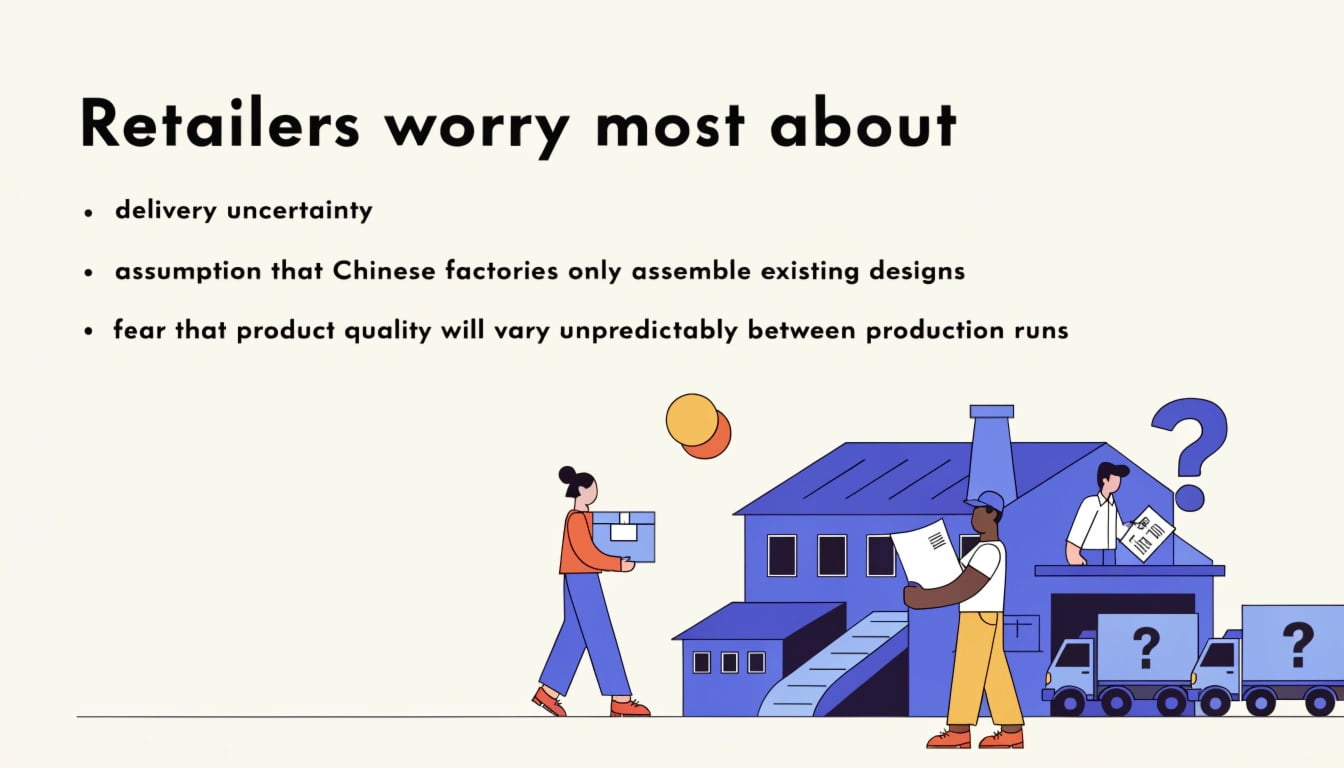
Most retailers have heard stories from their peers. A wholesaler orders 10,000 units for Black Friday. The supplier promises delivery by October. The cargo arrives in December. The entire sales season is lost. This is not a rare scenario. I see this concern come up in almost every early conversation between potential buyers and manufacturers.
The second assumption is more subtle. Many retailers believe Chinese factories can only assemble products from existing molds and circuits1. They think customization means choosing between three pre-made shell colors. This belief comes from past experiences with low-tier suppliers who lack design teams. When retailers discover that capable manufacturers offer full ODM services, their entire sourcing strategy changes.
The third fear relates to batch consistency. A retailer orders a sample. The console works perfectly. They place a 3,000-unit order. When the shipment arrives, 15% of the units have audio problems. Another 10% have screen defects. This quality variance destroys profit margins for e-commerce sellers. It ruins store reputation for physical retailers. I see this fear expressed most clearly by Amazon sellers who know that a 5% return rate can kill their listing ranking2.
These three concerns are not abstract. They represent real business losses. A missed delivery deadline means lost revenue during peak season. Inconsistent quality means customer complaints and negative reviews. Limited customization options mean competing on price alone in a crowded market. Retailers who overcome these fears do so by finding suppliers who have built specific systems to address each risk.
How Do Chinese Manufacturers Address the Assembly-Only Misconception?
The belief that Chinese factories only do basic assembly work limits what retailers think is possible. This misconception prevents buyers from asking about customization options that could differentiate their products.
Experienced Chinese gaming console manufacturers offer complete OEM/ODM services covering hardware specifications, external design, game library selection, and packaging customization—allowing retailers to build differentiated products without managing separate design teams.
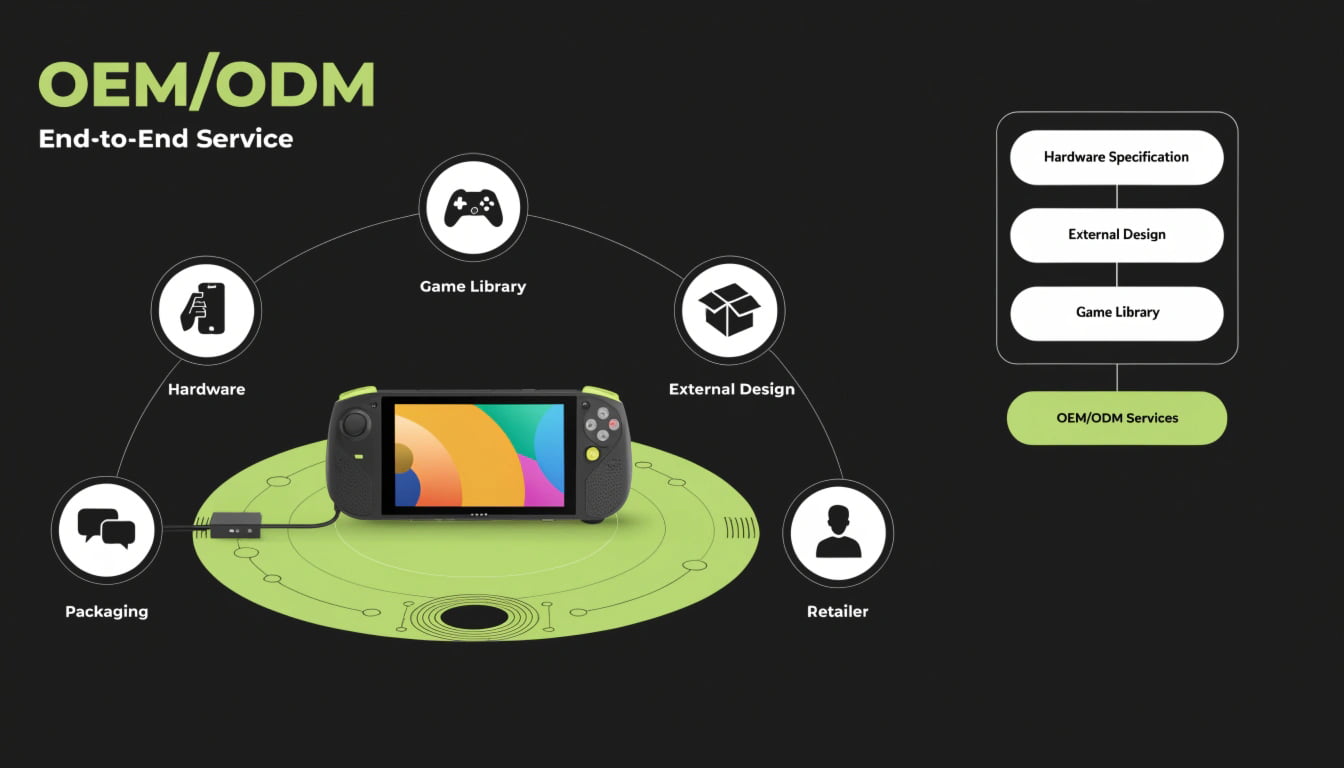
When a retailer first contacts a manufacturer with genuine ODM capability, the conversation shifts immediately. Instead of choosing between three existing console models, the retailer can specify exact requirements. They can request specific processor performance levels to match their target price point. They can design custom shell colors and textures that align with their brand identity. They can select which classic games get built into the device. They can design packaging that works for Amazon fulfillment centers or retail shelf display.
This level of customization requires integrated teams inside the factory. Design engineers who can modify circuit boards. Industrial designers who can create new shell molds. Quality control staff who can verify that customized components meet safety standards3. Packaging teams who understand international shipping requirements. Suppliers without these teams cannot offer true customization. They can only present existing products with minor modifications.
The game library customization matters more than most retailers initially expect. Different markets prefer different classic games4. A console loaded with Japanese RPGs will not sell well in markets where action platformers are more popular. A supplier who can customize the game library allows retailers to match their product to local consumer preferences. This creates competitive advantage that price alone cannot provide.
I see the impact of this customization capability most clearly when retailers return for second orders. Their first order might be a standard product with small modifications. By the third order, they are requesting entirely custom designs that match their brand strategy. This progression only happens when the supplier can support incremental customization without forcing the retailer to redesign everything from scratch.
Brand owners particularly value this capability. They need products that express their brand identity through physical design and user experience. A generic console with a logo sticker does not build brand value. A console with custom industrial design, unique color schemes, and carefully curated game libraries does. Suppliers who understand this distinction attract brand-focused buyers who will pay premium prices for differentiated products.
The turnaround time for custom design also matters. If customization requires six months of back-and-forth communication, the retailer misses market opportunities. Fast-moving gaming trends can emerge and fade within a single quarter5. Suppliers who can complete ODM projects in 45-60 days6 allow retailers to capitalize on market trends before they disappear.
Why Does Supply Chain Stability Determine Wholesaler Decisions?
Wholesalers operate on thin margins and tight schedules. Their entire business model depends on reliable inventory flow. When a supplier fails to deliver on time, the wholesaler loses contracts with downstream retailers.
Supply chain stability—demonstrated through on-time delivery rates, inventory management systems, and scalable production capacity—is the primary factor wholesalers evaluate when choosing gaming console suppliers.
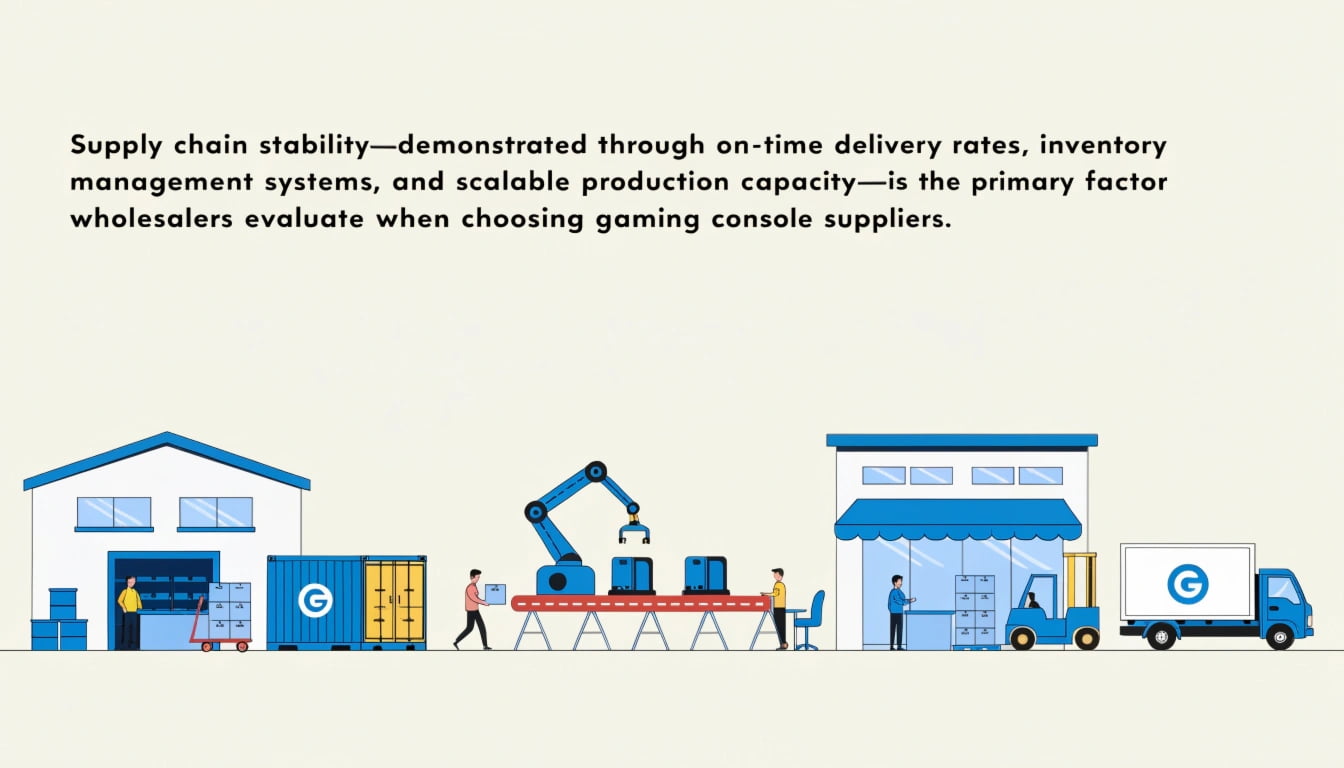
I see wholesalers approach supplier selection differently than other retailer types. They ask for past delivery performance data. They want to know the factory's maximum monthly production capacity. They inquire about backup component suppliers. They request detailed production schedules with milestone dates. These questions reflect hard-learned lessons from past supply failures.
The seasonal demand pattern in gaming creates specific challenges. Sales spike dramatically during Q4 holiday seasons. Wholesalers must build inventory months in advance to meet this demand. If a supplier cannot scale production from 5,000 units per month in June to 20,000 units per month in September, the wholesaler cannot fulfill their contracts. This production flexibility requires multiple production lines, trained assembly staff, and reliable component sourcing.
Inventory management systems inside the factory also affect delivery reliability. Suppliers who maintain buffer stock of common components can respond faster to rush orders. Factories that track component lead times can warn wholesalers about potential delays before they become critical problems. This transparency allows wholesalers to adjust their sales forecasts and communicate honestly with their own customers.
Large-scale production capacity matters even for wholesalers with moderate order sizes. A wholesaler might only order 3,000 units initially. But they need to know the supplier can handle 10,000-unit orders if their sales grow rapidly. Suppliers without this capacity force wholesalers to find new partners just when their business is scaling. This creates unnecessary risk and complexity.
The logistics dimension of supply chain stability extends beyond the factory gate. Experienced suppliers maintain relationships with freight forwarders who understand gaming electronics shipping requirements. They know how to package products to minimize damage during international transport. They understand customs documentation requirements for different destination countries. These capabilities seem small but they eliminate common causes of delivery delays.
Physical retailers share similar concerns but with different emphasis. They care more about replenishment speed than initial order size. A store chain might order 500 units per location. If a product sells well, they need to reorder within two weeks to avoid stockouts. Suppliers who can fulfill small repeat orders quickly become preferred partners for retail chains.
I consistently observe that wholesalers will pay slightly higher prices for suppliers with proven delivery track records. A 5% price premium is acceptable if it eliminates the risk of lost sales from late deliveries. This calculation changes when the supplier can demonstrate multi-year on-time delivery performance with other wholesalers in similar markets.
How Does Quality Control Impact E-commerce Seller Profitability?
E-commerce sellers face a different risk profile than wholesalers or physical retailers. Their reputation depends entirely on customer reviews and return rates. A single batch of defective products can destroy an Amazon listing's ranking.
Batch consistency and low return rates directly protect e-commerce sellers' profit margins and prevent negative reviews that eliminate sales velocity on online marketplaces.
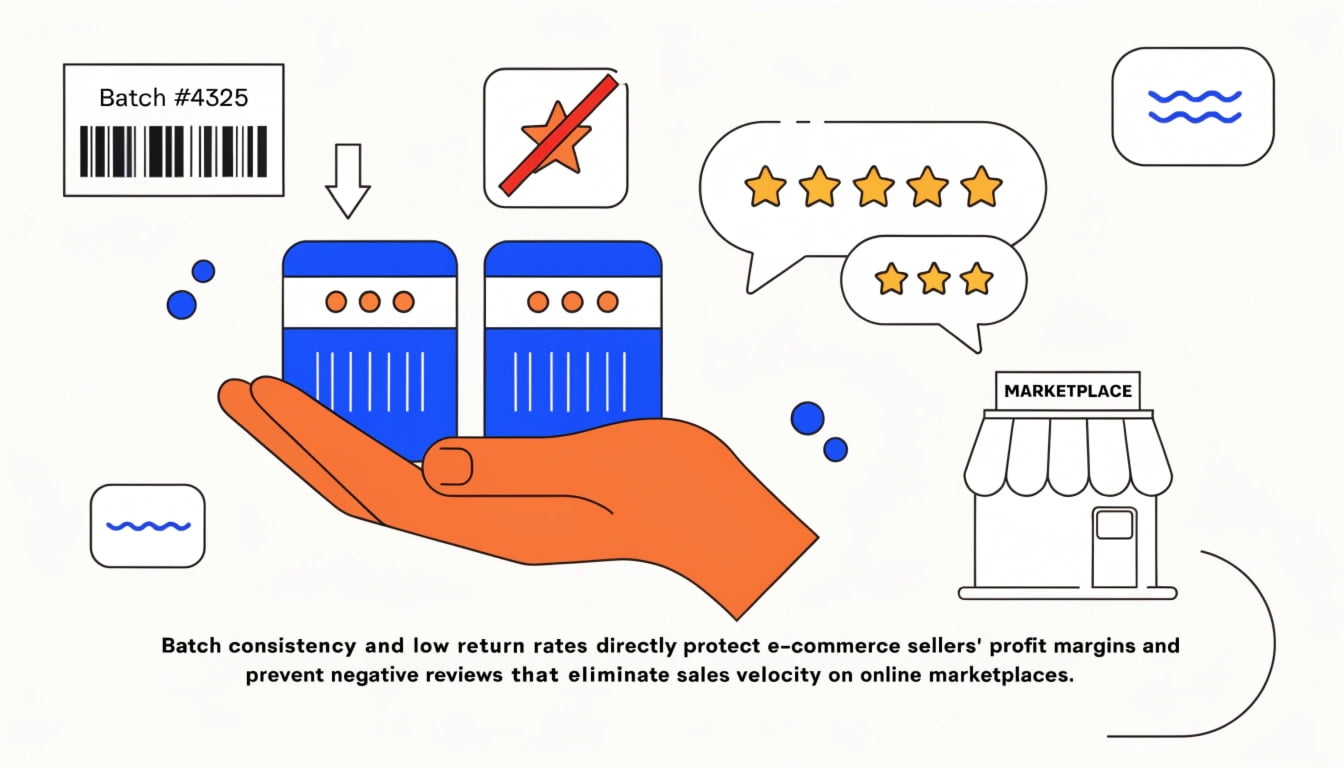
Amazon sellers typically share specific numbers when explaining their quality requirements. They cannot accept return rates above 3%. Every return costs them shipping fees, restocking time, and potential negative reviews. If a product's return rate reaches 5%, Amazon's algorithm starts suppressing the listing in search results. At 8%, Amazon may suspend the entire product listing. These are not hypothetical concerns. I see sellers mention these exact thresholds when evaluating new suppliers.
The quality control process inside the factory determines batch consistency. Suppliers with experienced QC teams test every unit before shipping. They check basic functionality like power-on, screen display, button response, and audio output. They verify that game files load correctly. They inspect shell assembly for gaps or rough edges. They confirm that packaging protects the device during rough handling.
Experienced QC teams catch problems that inexperienced inspectors miss. A slight misalignment in the LCD screen mount might not affect immediate functionality but will cause failure after 20 hours of use. A controller button with inadequate spring tension will feel fine initially but will stick after repeated pressing. These issues only emerge through systematic testing protocols that simulate real user behavior.
The cost of quality control represents about 3-5% of production cost for gaming consoles. Suppliers who skip this step can offer slightly lower prices. But this savings disappears quickly when returns start arriving. I see this pattern repeatedly: sellers choose the cheapest supplier for their first order, face 8% return rates, then switch to a supplier with proper QC for subsequent orders even at higher unit costs.
Component quality also affects long-term reliability. Gaming consoles use specific electronic components that vary in quality grade. Premium-grade capacitors cost 30% more than standard-grade but provide much longer lifespan. Sellers focused on building repeat customer relationships choose suppliers who use better components even when this increases unit cost slightly.
Testing protocols should match the product's target market. Consoles sold in hot climates need heat stress testing. Consoles marketed to children need drop testing. Consoles with wireless controllers need interference testing. Suppliers who customize testing protocols based on the target market help sellers avoid specific failure modes that would generate returns.
Shopify sellers and social media sellers have similar quality concerns but with different visibility patterns. A defective product on Amazon gets immediate negative reviews that suppress sales. A defective product on Shopify gets returned quietly but erodes the seller's brand reputation over time. Social media sellers rely heavily on influencer recommendations and user-generated content. A single viral video showing product failure can destroy months of marketing investment.
Sellers who operate across multiple channels need suppliers who can maintain consistent quality regardless of order size. A seller might order 500 units for Amazon, 200 units for their Shopify store, and 100 units for a social media campaign. If quality varies between these batches, the seller cannot diagnose which marketing channel is underperforming versus which batch had quality problems.
What Compliance Requirements Do International Retailers Prioritize?
International markets require gaming products to meet specific safety and electromagnetic compatibility standards. Retailers who skip compliance verification face costly product recalls and legal liability.
CE, FCC, and RoHS certifications are minimum requirements for accessing European and North American markets, with testing documentation becoming increasingly important for Amazon marketplace approval.
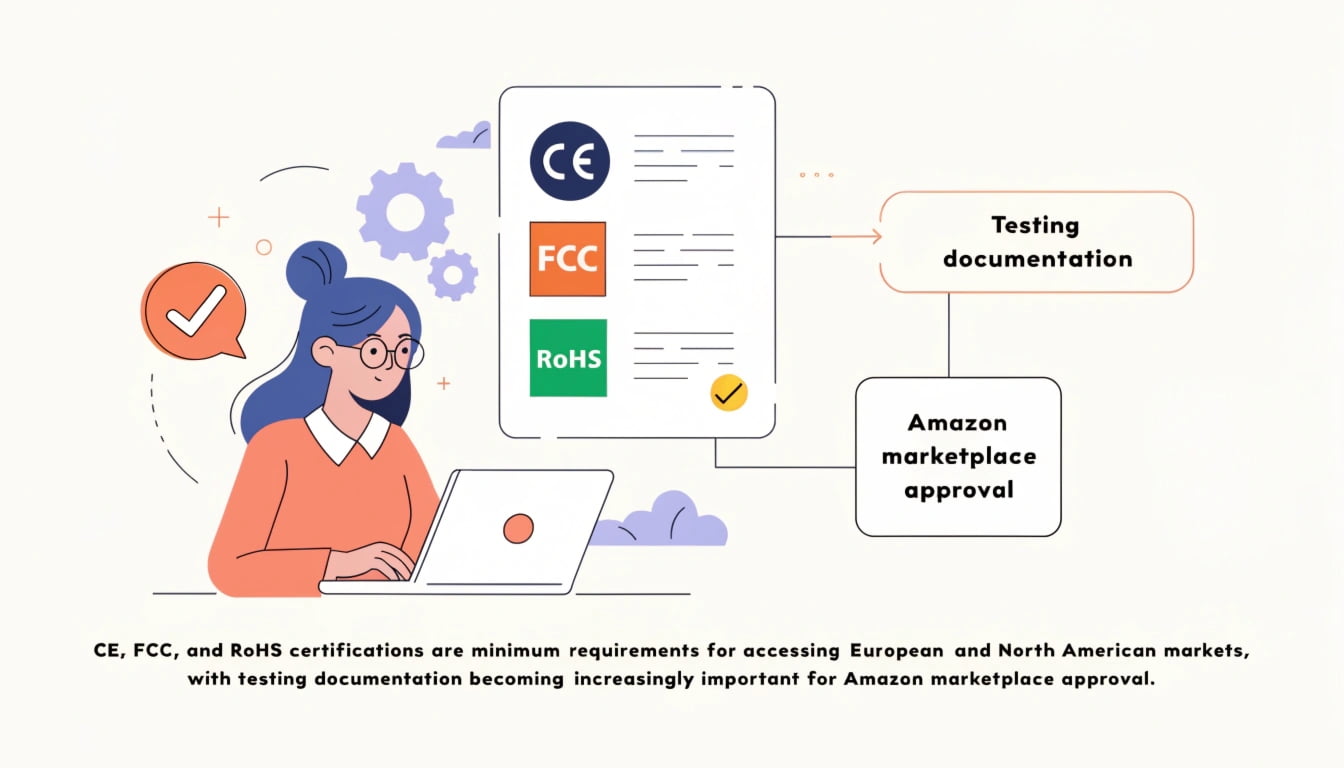
CE certification allows gaming products to enter European markets legally. This certification verifies that the product meets EU safety, health, and environmental protection standards. FCC certification performs a similar function for the United States, focusing specifically on electromagnetic interference standards. RoHS compliance restricts the use of hazardous materials in electronic products. These are not optional for legitimate retail channels.
Amazon has tightened compliance requirements significantly in recent years. They now request testing documentation for many product categories including gaming electronics. Sellers must provide proof that their products meet relevant safety standards. This requirement eliminates many low-quality suppliers who cannot provide legitimate certification documentation. I see sellers increasingly ask suppliers for certification documents before placing orders, not after products arrive.
The certification process affects production timelines. Testing a new gaming console model for CE and FCC compliance typically requires 4-6 weeks. Rush testing costs significantly more and may still require 2-3 weeks. Suppliers who maintain ongoing relationships with testing labs can sometimes expedite this process. This testing timeline must be included in the overall product development schedule or it delays market entry.
Component-level compliance also matters for ODM projects. If a retailer requests custom hardware specifications, every modified component must be verified for compliance. A supplier who changes screen suppliers or battery suppliers without compliance verification creates legal risk for the retailer. Experienced ODM manufacturers maintain documentation showing that all component suppliers also meet relevant standards.
Physical retailers often have additional insurance requirements. Retailers operating brick-and-mortar stores need products that meet their insurance provider's safety standards. A product that causes injury to a customer could trigger significant liability claims. Suppliers who understand these requirements help retailers avoid legal and financial risk.
The cost of compliance adds approximately 5-8% to total product development cost for new models. This includes testing fees, potential design modifications to meet standards, and documentation preparation. Suppliers who have already certified similar products can sometimes reduce this cost by leveraging existing test data. This cost reduction makes them more competitive for retailers launching similar products.
Certification also affects the customization process. Significant hardware modifications may require complete recertification. Minor changes like shell color or game library updates typically do not. Suppliers who understand these boundaries can advise retailers on which customization options avoid additional certification costs and delays.
Conclusion
Global retailers choose Chinese retro gaming console manufacturers because capable suppliers have transformed traditional manufacturing weaknesses into operational strengths—offering customization flexibility, supply chain reliability, and quality systems that directly reduce retailers' business risks and enable market differentiation.
"The influence of perceived design source (AI vs. human) on Chinese ...", https://pmc.ncbi.nlm.nih.gov/articles/PMC13086335/. Chinese manufacturing has transitioned significantly from original equipment manufacturing (OEM) to original design manufacturing (ODM) over the past two decades, though international buyer perceptions have not always kept pace with these capability improvements. Evidence role: historical_context; source type: research. Supports: the historical evolution of Chinese manufacturing from assembly-focused OEM to design-capable ODM services. Scope note: This provides context for the capability shift rather than direct evidence of the specific retailer perception described ↩
"How to Manage Amazon Returns and Reduce Return Rate - Jarvio", https://jarvio.io/blog/reduce-amazon-returns. E-commerce platforms typically incorporate return rates into seller performance metrics, though the specific thresholds and algorithmic weights vary by platform and are not publicly disclosed by Amazon. Evidence role: mechanism; source type: research. Supports: how product return rates affect e-commerce platform search rankings and seller performance metrics. Scope note: Amazon does not publish the exact parameters of its ranking algorithm, so the precise 5% threshold cannot be independently verified ↩
"Equipment Authorization | Federal Communications Commission", https://www.fcc.gov/engineering-technology/laboratory-division/general/equipment-authorization. International safety standards for consumer electronics, including IEC 62368-1 and regional certifications like CE and FCC, require that modified or customized components undergo appropriate conformity assessment to ensure continued compliance with safety requirements. Evidence role: mechanism; source type: government. Supports: regulatory requirements for safety verification of customized electronic components. ↩
"Of Time Gals and Mega Men: Empirical Findings on Gender ... - PMC", https://pmc.ncbi.nlm.nih.gov/articles/PMC8141853/. Academic research on video game consumption patterns has documented significant regional variations in genre preferences, influenced by cultural factors, historical market development, and local gaming traditions. Evidence role: general_support; source type: research. Supports: geographic variation in gaming genre preferences. Scope note: preference patterns evolve over time and may not apply uniformly to retro gaming specifically ↩
"Video Gaming Report 2026: The Next Era of Growth | BCG", https://www.bcg.com/publications/2025/video-gaming-report-2026-next-era-of-growth. Market research on consumer electronics trends indicates that product-specific trends in the gaming sector often have compressed lifecycles, though duration varies significantly by trend type and market segment. Evidence role: statistic; source type: research. Supports: the typical duration of gaming market trends. Scope note: trend duration varies widely depending on the specific product category and geographic market ↩
"Original design manufacturer - Wikipedia", https://en.wikipedia.org/wiki/Original_design_manufacturer. Industry analyses of ODM manufacturing indicate that development timelines for customized consumer electronics vary widely based on complexity, with simpler modifications achievable in shorter timeframes than complete redesigns. Evidence role: general_support; source type: research. Supports: typical development timelines for ODM electronics projects. Scope note: timeline benchmarks depend heavily on the scope of customization and existing platform maturity ↩