
Retro game console wholesale pricing can look simple at first, but many buyers quickly find that the “cheap unit price” is only one part of the real cost1. If MOQ, freight, platform fees, returns, and quality risk are ignored, the margin can disappear.2 I use this guide to help buyers build a safer pricing model.
A good 2026 retro game console wholesale pricing model should start with factory price, then add MOQ impact, product configuration, shipping, duties, taxes, warehousing, platform fees, advertising, returns, and replacement costs. Buyers should compare landed cost and resale risk, not just the lowest quotation from a supplier.
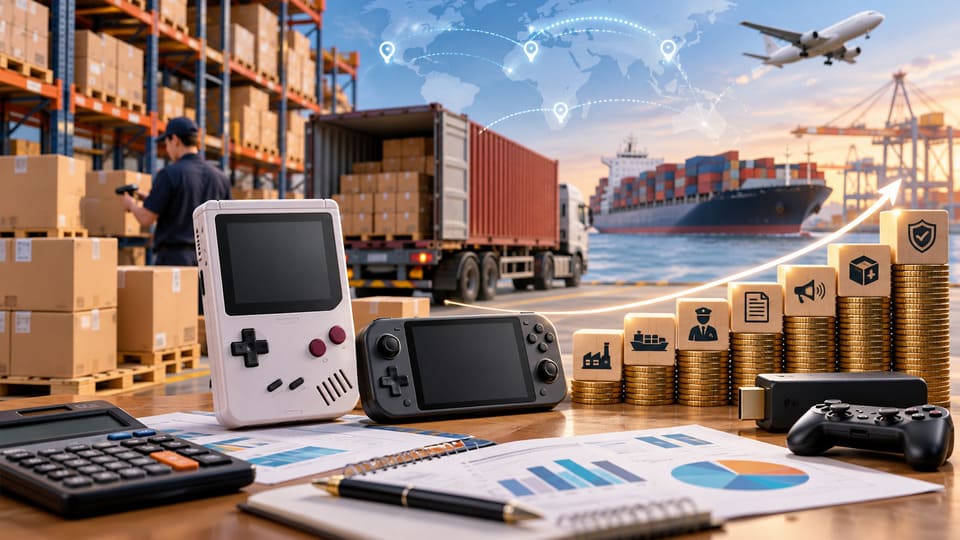
The main point is simple: wholesale buying is not only about getting the lowest price. It is about choosing the right product, the right order size, and the right supplier process so your expected margin can survive real-world costs.
How Does Retro Game Console Wholesale Pricing Work in 2026?
Many buyers ask for a quick price, but retro game console wholesale pricing depends on more than the model name. The problem is that two devices may look similar online, while their parts, accessories, packaging, and testing standards are different. That difference can change both cost and resale value.
Retro game console wholesale pricing in 2026 is mainly shaped by product type, chipset, screen size, memory, battery, controls, accessories, packaging, customization, testing requirements, and order quantity. Buyers should compare full specifications and quality standards before judging whether one quotation is truly cheaper than another.
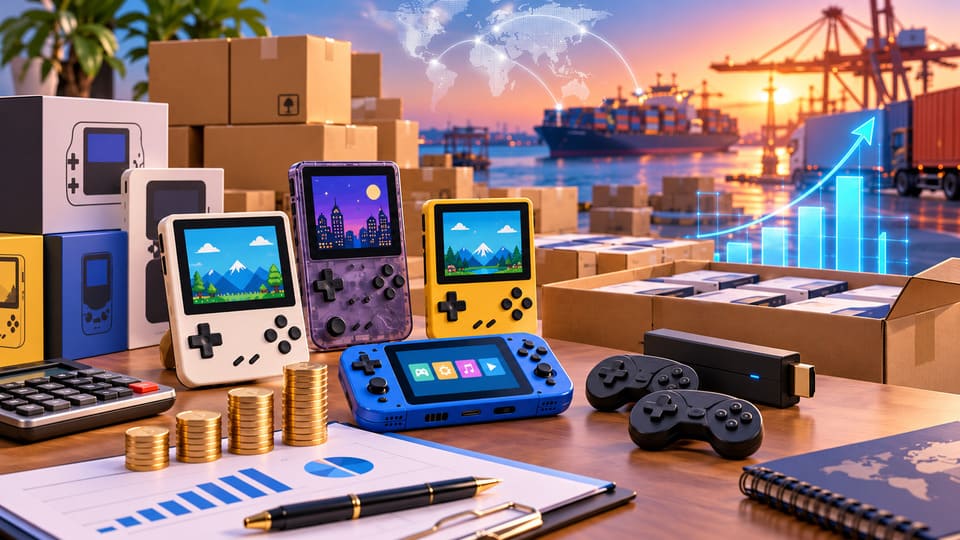
The product category is not one price category
In my daily communication with overseas buyers, I often see one common mistake: buyers treat “retro game console” as one fixed product category. It is not. A handheld console, an HDMI TV game stick, and a plug-and-play home console have very different cost structures.
For example, a handheld model may include:
- LCD or IPS screen
- Battery
- Main board
- Buttons and conductive pads
- Speaker
- Shell tooling
- Charging cable
- Memory card
- Gift box
- Manual
- Extra accessories
A TV stick or home console may focus more on:
- Wireless controllers
- HDMI output
- USB receiver
- Power adapter or cable
- System interface
- Packaging size
- Controller battery type
- Signal stability
So, when buyers compare prices, they should not only ask, “How much is this model?” A better question is:
“What exactly is included in this quotation, and what quality-control process supports this price?”
Main factors that affect wholesale cost
Here is a simple breakdown I use when explaining price differences to new B2B buyers.
| Cost Factor | Why It Matters | Buyer Question |
|---|---|---|
| Model type | Handheld, TV stick, and home console have different parts | Is this product right for my sales channel? |
| Screen | IPS, size, brightness, and resolution affect cost | Is the screen quality suitable for my retail price? |
| Chipset | Performance affects user experience and product positioning | Can the chipset support the games and system smoothly? |
| Memory | Storage size changes cost and perceived value | Is the memory option realistic for my target market? |
| Battery | Capacity and quality affect safety and complaints | What battery specification is used? |
| Controllers | Button feel and wireless stability affect returns | Are controllers tested before packing? |
| Accessories | Missing accessories cause after-sales cost | What is included in the standard package? |
| Packaging | Retail packaging affects shelf and online conversion | Is the box suitable for my market? |
| Testing | More testing adds cost but reduces risk | What tests are done before shipment? |
| MOQ | Larger orders often reduce unit cost | Can I test demand without overstocking? |
Why 2026 buyers should avoid “price only” sourcing
The global demand for nostalgic gaming products may continue, but any 2026 market forecast should be treated as to be verified unless you have reliable data for your exact country and sales channel. I prefer to help buyers make decisions from cost structure, not from hype.
For importers, distributors, and online sellers, the correct question is not:
- “Which supplier gives the lowest unit price?”
The better questions are:
- Can the product match my selling price?
- Can the MOQ match my cash flow?
- Can the quality level reduce return risk?
- Can the supplier support stable batches?
- Can the packaging and accessories match my channel?
At KLF, we quote many models such as handheld retro game consoles, HDMI TV game sticks, and plug-and-play home game consoles. From the supplier side, I have seen that buyers who compare specifications carefully usually make better sourcing decisions than buyers who only chase the lowest line on the quotation sheet.
What MOQ Makes Sense for Retro Game Console Wholesale Pricing?
MOQ can feel like a barrier, especially for new sellers. The problem is that a very small order may raise the unit cost, but a very large order may create inventory pressure. A smart MOQ should control risk while still leaving enough room for realistic margins.
The right MOQ for retro game console wholesale pricing depends on your sales channel, cash flow, freight method, customization needs, and market testing plan. For many buyers, a trial order is useful when it validates demand without making landed cost or retail price uncompetitive.
MOQ is a risk-control decision
I like to explain MOQ in a practical way: MOQ is not only a supplier rule. MOQ is also a buyer risk-control tool.
If the MOQ is too high, you may face:
- Slow-moving inventory
- Cash tied up in stock3
- Higher warehousing cost
- More pressure to discount
- Greater exposure if the model does not sell well
If the MOQ is too low, you may face:
- Higher unit price
- Higher freight cost per unit
- Limited customization options
- Lower priority in production planning
- Weaker margin after platform fees
So the best MOQ is rarely the smallest number or the largest number. It is the order size that lets you test the market while keeping your real landed cost under control.
Trial order vs. bulk order
Here is a simple way to compare order types.
| Order Type | Main Purpose | Advantage | Risk |
|---|---|---|---|
| Sample order | Product evaluation | Low commitment | Not enough to test real sales |
| Small trial order | Market testing | Controls inventory risk | Higher unit and freight cost |
| Medium order | Stable selling test | Better cost balance | Requires clearer demand estimate |
| Bulk order | Scaling sales | Lower unit cost | Higher cash and stock risk |
| OEM/ODM order | Brand building | Differentiation | Higher MOQ and longer lead time |
How I suggest buyers think about MOQ
For Amazon sellers, e-commerce sellers, and small distributors, I usually suggest building a simple MOQ decision sheet before placing an order. It does not need to be complicated.
You can ask:
-
How many units can I sell in 30–60 days?
This estimate should be conservative. If you are unsure, do not use your best-case forecast. -
What is my maximum acceptable stock risk?
Some buyers can hold inventory for months. Others need faster turnover. -
Does the MOQ allow air shipping, sea shipping, or both?
Air freight is faster but usually increases landed cost per unit. Sea freight can reduce freight cost per unit, but it takes longer and may require larger volume.4 -
Does customization change MOQ?
Logo printing, color box design, manuals, barcode labels, and private-label packaging may require higher MOQ because suppliers need to prepare materials and production steps. -
Can I reorder quickly if the product sells well?
A lower trial order makes sense only if replenishment is practical.
MOQ and margin must be considered together
A small MOQ may look safe, but the margin can become weak if freight is expensive. A large MOQ may reduce unit cost, but it can damage cash flow if sales are slower than expected.
For example, a buyer may see two options:
| Option | Factory Unit Price | MOQ | Freight Per Unit | Estimated Landed Cost |
|---|---|---|---|---|
| Small trial order | Higher | Lower | Higher | Medium to high |
| Bulk order | Lower | Higher | Lower | Lower |
The bulk order may look better on paper. However, if the buyer cannot sell the inventory quickly, the real cost includes storage, discounting, and cash pressure.
That is why I do not recommend choosing MOQ by price alone. I recommend matching MOQ to your sales confidence level. If you are entering a new country, new platform, or new product category, a trial order often gives valuable market feedback. If you already have confirmed demand, bulk purchasing may support stronger pricing.
How Should Buyers Calculate Landed Cost and Profit Margin?
Many buyers calculate margin from factory price, then feel surprised when profit becomes lower after shipment. The issue is simple: factory price is not your real cost. If you sell online or distribute locally, many extra costs appear before and after the sale.
Buyers should calculate profit margin from landed cost, not factory price.5 Landed cost should include product price, freight, duties, VAT/GST, customs clearance, warehousing, packaging changes, platform fees, advertising, payment fees, returns, replacements, and after-sales support. This gives a more realistic margin model.
A simple landed-cost formula
Here is the basic formula I use when discussing cost models with B2B buyers:
Landed Cost Per Unit = Factory Price + Freight + Duty + Tax + Clearance + Local Handling + Warehousing + Other Import Costs
Then the resale margin calculation becomes:
Gross Margin = Selling Price - Landed Cost - Channel Costs - After-Sales Costs
For online sellers, channel costs may include:6
- Platform commission
- Fulfillment fee
- Payment fee
- Advertising cost
- Coupon or promotion cost
- Return shipping
- Replacement units
- Customer service cost
For wholesalers or distributors, costs may include:
- Local delivery
- Sales commission
- Credit terms
- Retailer discount
- Storage
- Damaged carton allowance
- Warranty handling
Example margin model
The numbers below are only a structure example. Actual costs vary by product, supplier, route, country, tax rule, and sales channel. Buyers should verify all local charges with logistics providers, customs brokers, accountants, or qualified professionals.
| Cost Item | Example Amount Per Unit |
|---|---|
| Factory price | $18.00 |
| International freight | $2.50 |
| Duty and tax | To be verified |
| Customs and handling | $0.80 |
| Warehousing | $0.60 |
| Platform fee | $4.00 |
| Advertising | $3.00 |
| Return/replacement reserve | $1.50 |
| Estimated total cost before profit | $30.40 + tax/duty |
If the retail selling price is $39.99, the margin is not based on $18.00. It is based on the full cost stack. That is the difference between a nice-looking quotation and a real business result.
Channel matters a lot
Different buyers need different margin models.
| Buyer Type | Main Cost Pressure | Pricing Focus |
|---|---|---|
| Importer | Freight, duties, bulk cash flow | Stable landed cost |
| Wholesaler | Local resale price | Volume margin |
| Distributor | Retailer terms and support | Brand and supply stability |
| Amazon seller | Fees, ads, returns | Conversion and review risk |
| Independent e-commerce seller | Ads, payment fees, fulfillment | Product differentiation |
| Gift company | Packaging and deadline | Customization and delivery reliability |
I have noticed that Amazon and marketplace sellers often pay more attention to product photos, packaging, reviews, and return rates. Importers and distributors often care more about stable supply, carton packing, batch consistency, and price levels across repeat orders.
Both sides are right. They just sell through different systems.
Do not forget after-sales reserve
After-sales cost is easy to ignore before ordering.7 However, retro gaming devices are electronic products, so buyers should plan a realistic reserve for customer issues.
Possible after-sales costs include:
- Units damaged during transport
- Missing cables, manuals, or accessories
- Controller connection complaints
- Battery or charging complaints
- Screen defects
- Software setting confusion
- Customer returns due to expectations
- Replacement shipments
A stronger QC process may increase the purchase price slightly, but it can reduce later problems.8 Buyers should ask suppliers about testing steps, accessory checks, packaging protection, and how after-sales claims are handled.
At KLF, we focus on B2B supply, so these conversations are normal. A serious buyer usually asks about product inspection, carton condition, accessories, and shipping support before finalizing the order. I see that as a positive sign, not a difficult request.
Why Can the Lowest Retro Game Console Wholesale Pricing Increase Risk?
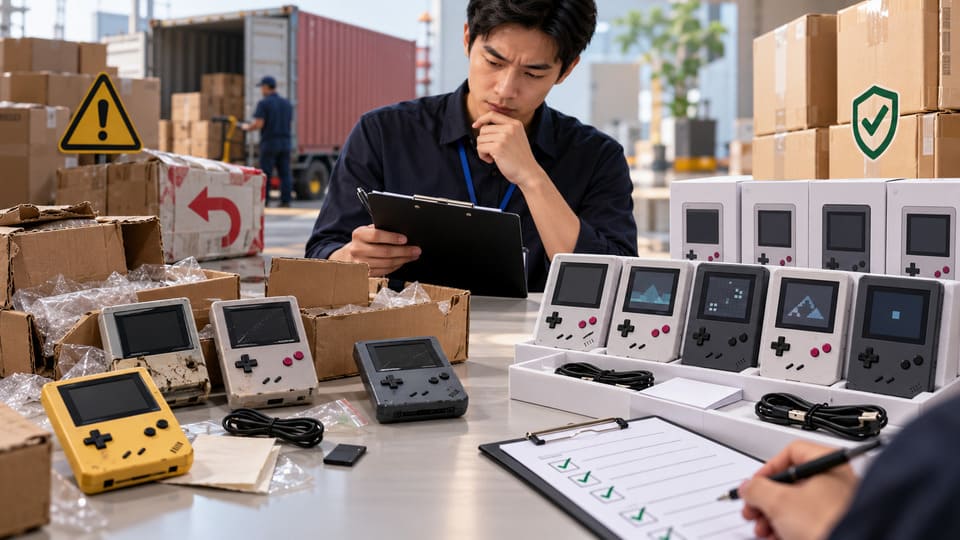
Low prices are attractive, especially when buyers compete in crowded online markets. The problem is that a very low quote may hide weaker components, missing accessories, unstable batches, or limited testing. If returns increase, the cheapest order can become the most expensive one.
The lowest retro game console wholesale pricing can increase risk when it reduces product consistency, accessory completeness, packaging quality, testing time, or after-sales support. Buyers should compare total resale risk, including defect rates, returns, replacement cost, and supplier communication, before choosing a quotation.
Cheap price vs. safe cost
There is a big difference between a competitive price and an unsafe price. A competitive supplier reduces cost through production efficiency, stable sourcing, and clear processes. An unsafe low price may come from cutting corners.
Possible hidden risks include:
- Lower-grade screen
- Weak battery performance
- Poor button feel
- Unstable controller connection
- Thin packaging
- Missing accessories
- Inconsistent memory card quality
- Limited pre-shipment testing
- No clear after-sales process
- Product description mismatch
For B2B buyers, these problems do not end with one unhappy customer. They can affect platform ratings, retailer trust, refund rate, and future sales.
Supplier evaluation checklist
Before placing an order, buyers should compare suppliers across more than price.
| Evaluation Area | What to Check | Why It Matters |
|---|---|---|
| Product specification | Screen, memory, battery, accessories | Prevents quotation mismatch |
| Sample consistency | Sample vs. bulk production | Reduces batch surprise |
| QC process | Function test, charging test, accessory check | Lowers return risk |
| Packaging | Gift box, carton strength, labels | Protects goods and supports retail |
| MOQ flexibility | Trial order support | Helps test demand |
| Customization | Logo, box, manual, barcode | Supports private-label sales |
| Communication | Fast and clear replies | Reduces order mistakes |
| Shipping support | Export packing and logistics coordination | Reduces delivery problems |
| After-sales handling | Replacement policy and claim process | Controls post-sale cost |
Quality control is part of pricing
Some buyers ask why two suppliers quote different prices for a similar-looking handheld console. One reason may be the testing standard. Testing takes labor time. Better packaging also costs money. More stable accessories cost more than lower-grade accessories.
A buyer should ask:
- Is every unit powered on before packing?
- Are buttons and controls checked?
- Are screens checked for visible defects?
- Are charging cables and accessories counted?
- Are cartons checked before shipment?
- Can the supplier support inspection photos or videos?
- Can a third-party inspection be arranged if needed?
For larger or higher-risk orders, buyers may also consider qualified third-party inspection. I do not suggest relying only on a promise. Product compliance, safety requirements, import rules, and intellectual property matters should also be checked by qualified professionals in the buyer’s market.
Private-label buyers need extra caution
Private-label orders can create better differentiation, but they also add cost and risk. Logo printing, packaging design, manuals, stickers, and carton marks need careful confirmation.
Before approving production, buyers should check:
- Logo file format
- Print color
- Box design
- Barcode and SKU label
- Manual language
- Product photos and listing claims
- Country-specific compliance marks, if applicable
- Carton information
- Final packing list
A mistake in private-label packaging can be expensive because the product may not be ready for sale even if the device works. That is why private-label pricing should include design confirmation, sample approval, and extra communication time.
How Can Buyers Build a Better Retro Game Console Wholesale Pricing Plan?
A buyer without a pricing plan may choose products emotionally. The problem is that a popular-looking device may not fit the buyer’s channel, budget, or after-sales capacity. A simple plan helps connect product selection, MOQ, landed cost, and target resale price.
A better retro game console wholesale pricing plan starts with the target market, then works backward from selling price, landed cost, required margin, MOQ, shipping method, and supplier quality level. This method helps buyers choose models that fit their business instead of chasing random cheap products.
Start from your sales channel
Each channel needs a different product strategy.
If you sell on marketplaces, you may need:
- Strong photos
- Clear product title
- Stable reviews
- Low return rate
- Attractive packaging
- Fast fulfillment
If you sell to retailers, you may need:
- Good carton packing
- Retail-ready boxes
- Consistent supply
- Reasonable warranty handling
- Clear wholesale margin
- Local-language manuals
If you sell through gift or promotion channels, you may need:
- Custom logo
- Custom packaging
- Fixed delivery date
- Simple operation
- Easy customer instructions
- Bulk order coordination
This is why I always prefer to ask buyers about their sales channel before recommending a model. A console that is good for an online store may not be the best choice for a supermarket shelf or a gift campaign.
Work backward from selling price
A practical pricing plan can follow these steps:
-
Set your expected selling price
Use your market research, competitor listings, retailer feedback, and customer positioning. -
Estimate all channel costs
Include platform fees, advertising, payment fees, local shipping, and returns. -
Calculate your maximum landed cost
This is the highest cost you can accept while keeping your target margin. -
Choose product models within that cost range
Do not force a premium product into a low-price sales channel. -
Match MOQ to your demand confidence
Use trial orders when demand is uncertain. Use larger orders when demand is proven. -
Confirm supplier quality and after-sales process
A slightly better product may protect more profit than a cheaper risky product.
Product positioning matters
Retro gaming products can be positioned in different ways:
| Positioning | Product Type | Buyer Focus |
|---|---|---|
| Entry-level gift | Simple TV game stick or basic handheld | Low cost, easy use |
| Mid-range online retail | Popular handheld models | Balance of price and experience |
| Premium private label | Better screen, packaging, support | Brand value and lower complaint rate |
| Distributor assortment | Multiple models | Stable supply and margin ladder |
| Promotion campaign | Simple plug-and-play device | Deadline and packaging control |
At KLF, we supply different handheld and TV console models, including popular models such as R36S, R36XX, R46S, HC8000, X80, Project X, PX Pro, M8 TV Stick, M15, and G7. I mention these not as a fixed price list, but to show that buyers usually need a product mix. One model may support entry-level sales. Another may support higher-value retail.
Build a margin safety buffer
No margin model is perfect. Freight can change. Ad cost can rise. Some units may be returned. Retailers may request discounts. Customs rules may require extra documents. Because of this, I suggest buyers leave a margin buffer instead of planning with perfect numbers.
A safe plan should include:
- A return/replacement reserve
- A freight fluctuation reserve
- A promotion discount reserve
- A small allowance for damaged cartons
- A buffer for exchange-rate movement
- A realistic advertising budget
This does not guarantee profit. Nothing can guarantee profit in every market. But it makes your decision more professional and less emotional.
Frequently Asked Questions
What is the most important part of retro game console wholesale pricing?
The most important part is landed cost, not factory price. Buyers should include freight, duties, taxes, customs clearance, warehousing, platform fees, advertising, returns, and replacements. This gives a more realistic view of whether the product can be profitable in a specific sales channel.
Is a lower MOQ always better for new buyers?
A lower MOQ can reduce inventory risk, but it may increase unit cost and freight cost per unit. New buyers should use trial orders to test demand, but they still need to check whether the landed cost allows a realistic resale margin.
Why do similar retro game consoles have different wholesale prices?
Similar-looking consoles may use different screens, chipsets, batteries, memory, controls, accessories, packaging, and testing standards. Buyers should compare full specifications and QC processes before deciding that one supplier is cheaper or more expensive.
Should I choose air freight or sea freight for wholesale orders?
Air freight is faster and useful for urgent or small trial orders, but it usually costs more per unit. Sea freight can lower freight cost for larger orders, but it takes longer. Buyers should compare timing, cash flow, and landed cost before choosing.
Can I customize retro game consoles with my logo and packaging?
Yes, many suppliers support OEM/ODM, logo customization, packaging customization, and private-label services. However, customization may affect MOQ, lead time, unit cost, and sample approval steps. Buyers should confirm artwork, box design, labels, and manuals before production.
Conclusion
Retro game console wholesale pricing in 2026 should be treated as a full business calculation, not a race to the lowest unit price. Buyers should compare product configuration, MOQ, landed cost, channel fees, quality control, and after-sales risk before placing orders. From my supplier-side experience at KLF, the strongest buyers usually ask clear questions before they negotiate price. If you are planning a trial order, wholesale order, or private-label project, contact KLF to discuss suitable models, MOQ options, packaging needs, and export support.
"Determine Total Export Price", https://www.trade.gov/determine-total-export-price. A neutral import-cost source defines landed cost as a broader measure that includes purchase price plus transportation, duties, taxes, and related import charges, supporting the point that the quoted unit price is not the buyer's full cost. Evidence role: definition; source type: government. Supports: The source should define landed cost or import cost as including expenses beyond the supplier's unit price.. Scope note: This supports the general pricing principle, not the specific cost structure of retro game consoles. ↩
"Shipping Fees and Product Assortment in Online Retail", https://www.hbs.edu/ris/Publication%20Files/19-034_b2382177-a462-447e-86f8-690d1ea7af18.pdf. Research on total cost of ownership in purchasing treats supplier price as only one element of cost and includes logistics, inventory, quality, and service-related costs when evaluating margins. Evidence role: general_support; source type: paper. Supports: The source should explain that procurement decisions should consider total ownership costs, including logistics, inventory, quality, and after-sales costs.. Scope note: The support is contextual and does not quantify the margin impact for this specific product category. ↩
"Impact of Cash Flow on Business Stability", https://online.ysu.edu/degrees/business/mba/general/cash-flow-on-business-stability/. Inventory-management literature treats stock as a use of working capital and identifies holding costs such as storage, financing, shrinkage, and obsolescence. Evidence role: general_support; source type: education. Supports: The source should explain that inventory ties up working capital and creates holding costs such as storage, obsolescence, and financing costs.. Scope note: The source supports the inventory-risk concept generally rather than establishing an optimal MOQ for retro consoles. ↩
"Air Freight: A Market Study with Implications for Landlocked ...", https://www.worldbank.org/en/topic/transport/publication/air-freight-study. International logistics sources commonly distinguish air freight as faster but higher-cost and ocean freight as slower but more economical for larger or less time-sensitive shipments. Evidence role: general_support; source type: institution. Supports: The source should compare air and ocean freight in terms of speed, cost, and suitability for shipment size.. Scope note: Actual cost differences depend on route, season, fuel prices, shipment density, and service level. ↩
"Import Tariffs & Fees Overview and Resources", https://www.trade.gov/import-tariffs-fees-overview-and-resources. Import-pricing guidance describes landed cost as the cost base that includes the purchase price and import-related charges, supporting the use of landed cost rather than factory price when estimating resale margin. Evidence role: definition; source type: government. Supports: The source should show that import pricing analysis uses landed cost, including transport, duties, taxes, and handling, rather than supplier price alone.. Scope note: The source would not validate the article's example numbers or any specific tax treatment. ↩
"Competition Market Study of Online Marketplaces in ...", https://www.oecd.org/en/publications/competition-market-study-of-online-marketplaces-in-poland-latvia-and-lithuania_3134e707-en/full-report/online-marketplaces-and-their-ecosystems_abc7578f.html. E-commerce research identifies platform access, fulfillment, payment processing, marketing, and returns management as recurring cost categories for online retailers. Evidence role: general_support; source type: research. Supports: The source should support that e-commerce sellers face multiple cost categories beyond product acquisition, including platform, fulfillment, payment, marketing, and return costs.. Scope note: The cited evidence would describe common online retail costs and may not cover every fee structure used by every marketplace. ↩
"Warranty Reserve: How Brands Account for Claim Costs .. ...", https://www.claimlane.com/resources/blog/warranty-reserve-accounting. Accounting guidance on warranty and return obligations requires businesses to estimate expected future claims when obligations are probable and measurable, supporting the practice of reserving for after-sales costs. Evidence role: general_support; source type: institution. Supports: The source should support that expected warranty or return obligations are recognized or estimated as future costs when they are probable and measurable.. Scope note: Accounting treatment depends on jurisdiction and contract terms, and the source does not establish a specific reserve percentage. ↩
"Reducing the Costs of Poor Quality: A Manufacturing Case ...", https://scholarworks.waldenu.edu/context/dissertations/article/6608/viewcontent/Faciane_waldenu_0543D_20845.pdf. Quality-management literature describes prevention and appraisal activities as upfront costs that can reduce internal and external failure costs such as defects, rework, returns, and warranty claims. Evidence role: mechanism; source type: paper. Supports: The source should explain the cost-of-quality framework, including prevention and appraisal costs versus internal and external failure costs.. Scope note: The relationship is conceptual and depends on the effectiveness of the specific QC process. ↩