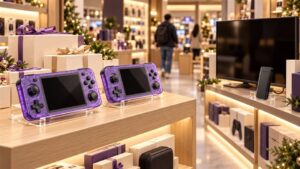
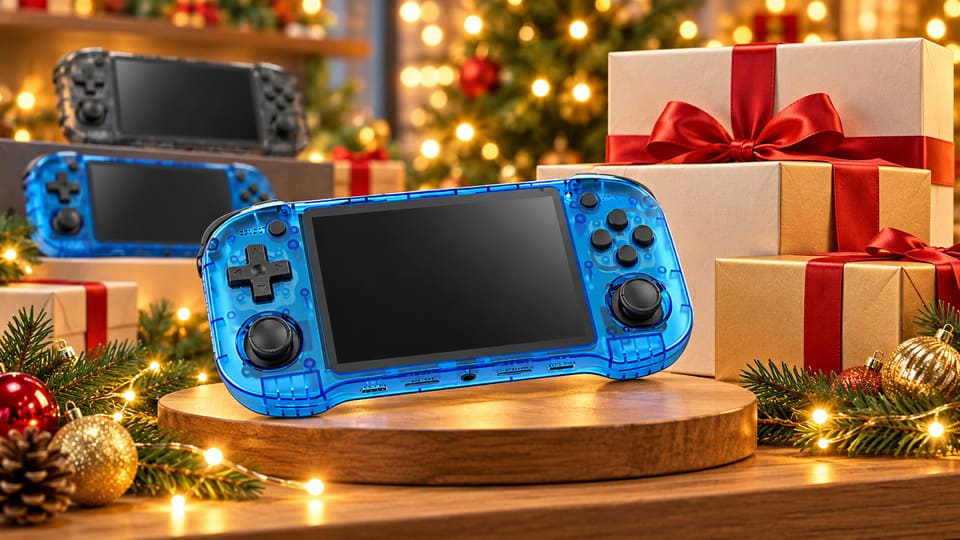

Retro game consoles can look like an easy holiday product, but the wrong mix can quickly become slow inventory. Buyers may chase one “hot” model, then face returns, weak packaging, or poor sell-through. I prefer a safer approach: choose wholesale models by sales channel, target customer, quality stability, and gift appeal.
The best retro game consoles to wholesale for Christmas 2026 and New Year 2027 are the models that match your channel, not just the models with the highest game count or lowest price. For most B2B buyers, a balanced mix should include handheld consoles, HDMI TV game sticks, plug-and-play TV consoles, and small trial-order options.
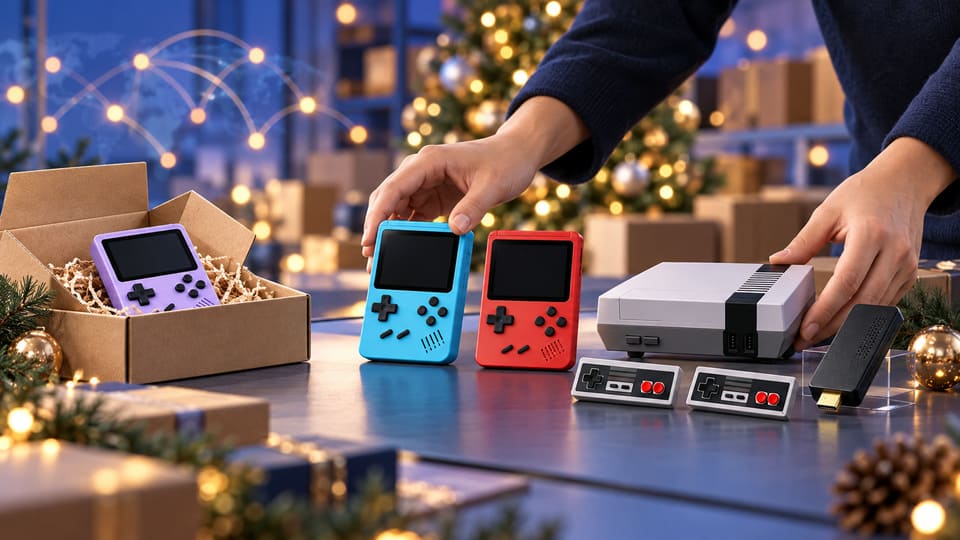
In my work with overseas wholesalers, importers, and online sellers, I often hear the same question: “Which model should I buy first?” My honest answer is usually: “Let us first talk about where you sell, how you ship, and how much return risk you can accept.”
Which retro game consoles fit e-commerce fast-moving holiday sales?
Online sellers need retro game consoles that are easy to explain, easy to ship, and less likely to create return problems. The problem is that holiday traffic moves fast. If a listing gets bad reviews early, sales can drop quickly, even when demand is strong.
For e-commerce channels, the better wholesale choices are compact handheld retro game consoles, stable HDMI TV game sticks, and clear-entry models with simple selling points. Online sellers should prioritize product consistency, accessory quality, packaging protection, and listing-friendly features over only chasing the lowest unit price.
What I usually check for online sellers
For Amazon, Shopee, TikTok Shop, Mercado Libre, and independent stores, I look at the product through a return-risk lens. A model may look attractive on a spec sheet, but online buyers judge it by the full experience: photos, delivery condition, battery life, screen feel, menu usability, and accessories.
In many buyer discussions, I see three common e-commerce product roles:
| Product role | Typical option | Why it works online | Main risk to check |
|---|---|---|---|
| Fast-moving entry item | Basic handheld console | Easy price point, simple listing | Screen quality, buttons, battery |
| Mid-range gift item | R36S / R36XX-style handheld | Stronger perceived value | Firmware stability, packaging |
| TV family item | HDMI TV game stick like M8 TV Stick | Easy “plug and play” message | Controller quality, signal stability |
I do not recommend choosing only by game count. A listing that says “20,000 games” may look strong, but buyers still complain if the controller feels weak or the menu is confusing. In holiday sales, bad reviews are expensive1 because peak demand windows are short.
Better e-commerce selection logic
When I help buyers think through e-commerce procurement, I usually suggest this order:
-
Choose 1–2 main models first.
Do not open with too many SKUs unless you already have sales data. -
Test packaging under real shipping conditions.2
A console that looks fine at the factory can still arrive damaged after courier handling. -
Check accessories carefully.
Cables, chargers, controllers, TF cards, and user manuals affect the customer’s first impression. -
Prepare clear listing content.
Buyers should know whether the product is handheld, TV plug-and-play, rechargeable, HDMI-based, or suitable for two players. -
Start with trial orders when entering a new market.
Small test orders help reduce the risk of overstocking the wrong model before Christmas.
At KLF, I see online sellers ask more detailed questions before peak seasons. They ask about packaging size, carton quantity, sample testing, logo printing, and whether a model has stable repeat supply. These questions matter because e-commerce is not only about demand. It is also about reviews, delivery cost, and after-sales pressure3.
Which retro game consoles work best for offline gift and display shelves?
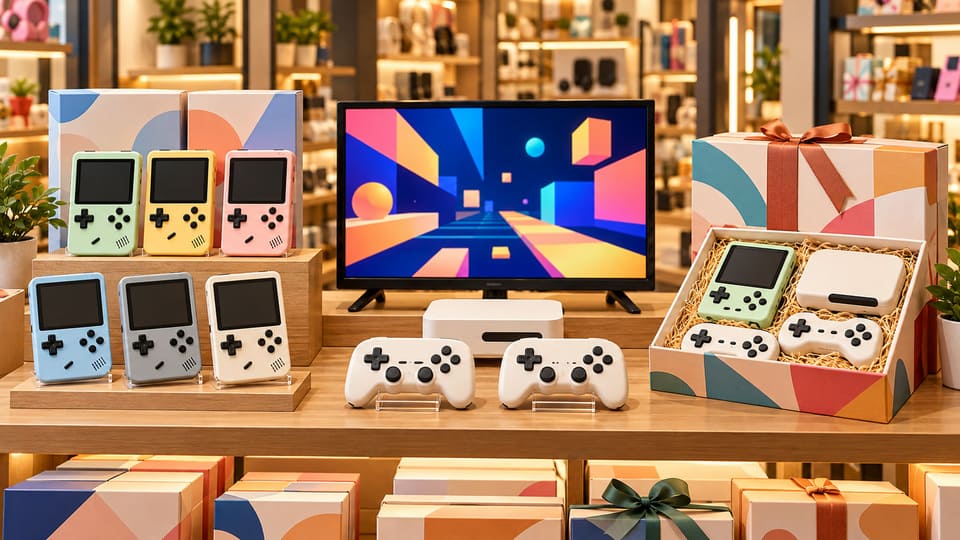
Offline stores need retro game consoles that shoppers can understand in a few seconds. The problem is that customers often decide by looking at the box, the screen, or a quick demo4. If the product does not feel giftable, stores may struggle to move stock before the season ends.
For offline gift shops, electronics stores, and gaming retailers, the better choices are visually clear handheld consoles, plug-and-play TV consoles, and boxed gift sets. Buyers should focus on packaging design, demo appeal, shelf presentation, and easy explanation rather than only technical specifications.
Why offline buyers need a different product mix
Offline selling has a different rhythm from online selling. A shopper may walk into a store, see several electronics gifts, and compare them quickly. They may not read a long product description. They may ask one simple question: “Is this fun for kids and adults?”
That is why I usually suggest offline buyers think in terms of gift scenes:
- Christmas gifts for children
- New Year family entertainment
- Small electronics gifts for offices or events
- Nostalgic gifts for adults
- Retail display products near checkout counters
A handheld console with a bright screen and nice packaging can work well because the value is visible. A TV game stick can work when the store can show a simple “connect to TV and play” message. A plug-and-play home console can work when the package shows family gaming clearly.
Offline wholesale comparison
| Buyer type | Better product focus | Helpful feature | Procurement note |
|---|---|---|---|
| Gift store | Compact handheld console | Nice box, color options | Check packaging quality |
| Electronics store | Mid-range handheld + TV game stick | Demo-friendly features | Test samples before bulk order |
| Game shop | Wider model range | Stronger product story | Avoid too many similar SKUs |
| Distributor | Mixed assortment | Multiple price levels | Confirm stable supply |
My practical advice for physical retail
I often tell offline buyers not to overcomplicate the first purchase. A shelf with five similar handheld models can confuse customers. A cleaner mix may perform better:
- One entry handheld model for price-sensitive buyers
- One mid-range handheld model for gift buyers
- One HDMI TV game stick for family entertainment
- One boxed home console for higher perceived value
Packaging deserves special attention. During Christmas and New Year, a product is not only an electronic device. It is also a gift. Weak packaging can make a product look cheap5, even when the device itself is acceptable.
Offline buyers should also ask suppliers for product photos, carton information, packaging customization options, and logo printing details early. OEM/ODM work takes time. If a buyer wants private-label packaging for Christmas 2026, it is safer to start discussion and sample approval months before peak ordering.
How should buyers balance handheld retro game consoles and TV game devices?
Many buyers like handheld retro game consoles because they are easy to sell, but TV game devices also have a role. The problem starts when buyers choose only one product type. They may miss family-use demand, gift bundles, or lower-price trial options.
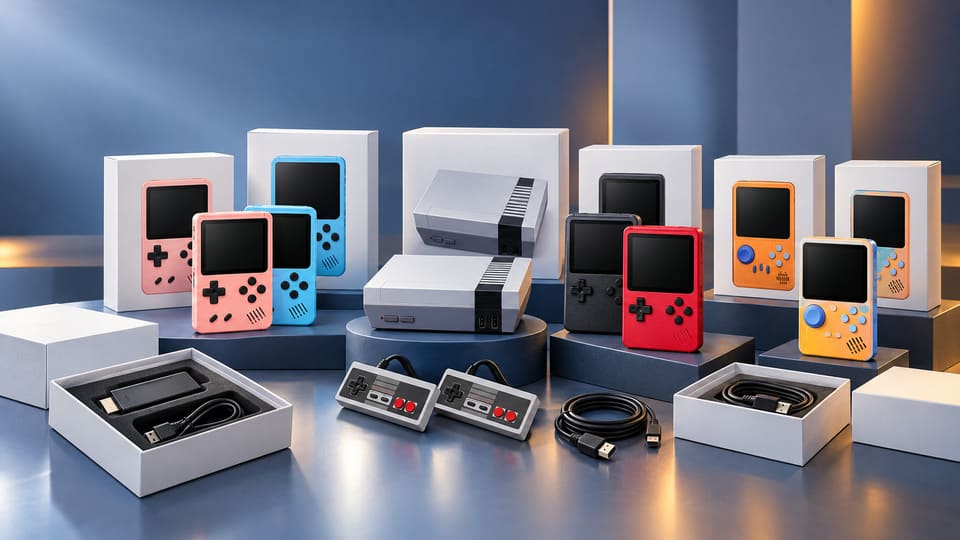
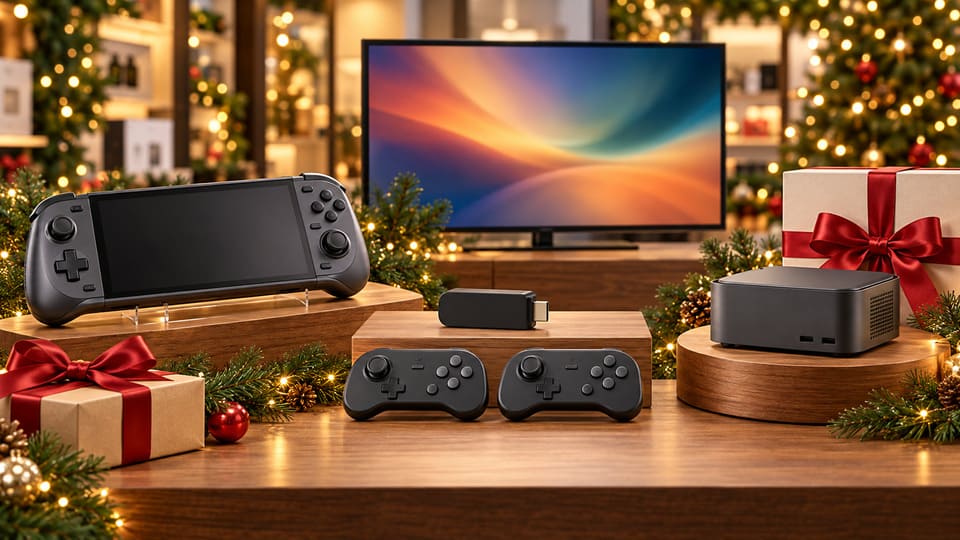
A safer holiday assortment usually combines handheld retro game consoles, HDMI TV game sticks, and plug-and-play home consoles. Handheld models serve personal gaming and gifting, while TV devices serve family entertainment and lower-barrier holiday purchases. The right balance depends on market price level, channel, and buyer risk tolerance.
Product roles inside a holiday assortment
I do not see handheld and TV products as direct enemies. I see them as different tools. Each one solves a different buying reason.
Handheld retro game consoles are strong when the customer wants a personal device. Models such as R36S, R36XX, R46S, X80, HC8000, and similar categories may appeal to buyers who want visible hardware value. The screen, buttons, body color, and packaging can all help the product feel like a real gift.
HDMI TV game sticks such as M8 TV Stick-style products are useful when the customer wants simple family entertainment. The selling point is not portability. The selling point is convenience: connect to a TV, use controllers, and play together.
Plug-and-play home consoles can sit between these two groups. They may offer stronger gift-box presentation and a more traditional living-room gaming experience.
A simple assortment model
For many new wholesale buyers, I like this starting framework:
| Assortment share | Product type | Reason |
|---|---|---|
| 50% | Handheld consoles | Broad gift appeal and strong visual value |
| 25% | HDMI TV game sticks | Family entertainment and compact shipping |
| 15% | Plug-and-play home consoles | Higher gift-box value |
| 10% | Trial or niche models | Market testing without heavy risk |
This is not a universal rule. A distributor in Latin America may choose a different mix than an Amazon seller in Europe. A gift company may prefer lower MOQ and custom packaging. A gaming store may want more model variety.
What I ask buyers before recommending a mix
When a buyer asks me which models to wholesale, I usually ask:
-
Where will you sell?
Online marketplace, offline shop, distributor network, or private-label channel? -
What price range can your customers accept?
A good model at the wrong price level may still move slowly. -
Do you need logo or packaging customization?
Private-label work affects lead time and MOQ. -
How much inventory risk can you take?
Trial orders and mixed cartons may be safer for new markets. -
What after-sales support do you expect?
Spare parts, replacement policy, and QC records can matter during peak season.
For Christmas 2026 and New Year 2027, I would avoid treating any single model as a guaranteed winner. Holiday demand can shift. Platform rules can change. Freight cost can move. A balanced mix gives buyers more flexibility.6
What quality checks reduce holiday wholesale risk for retro game consoles?
Holiday buyers often focus on price first, but quality problems can destroy profit. The issue is simple: returns, bad reviews, replacement costs, and unsold inventory can cost more than the small savings from a cheaper unit price.
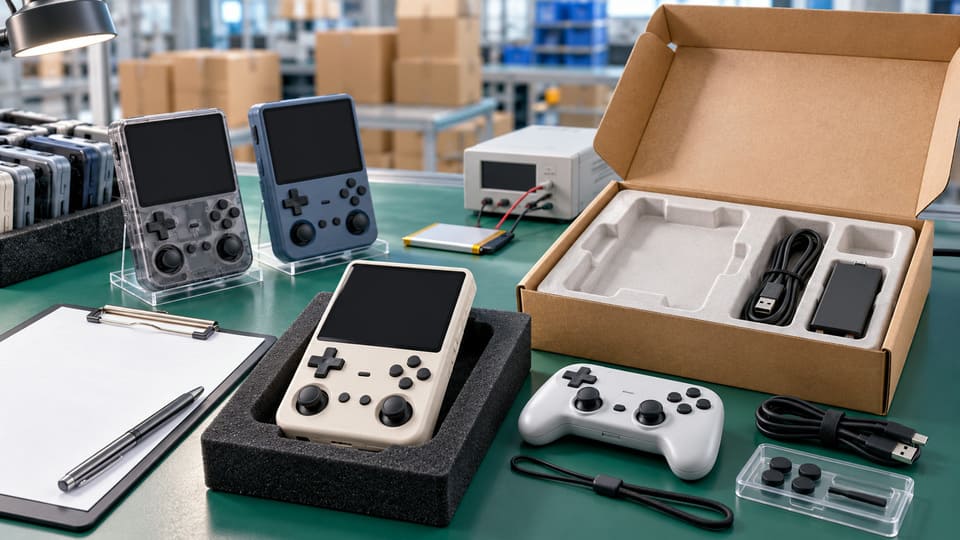
To reduce risk when wholesaling retro game consoles, buyers should check samples, packaging, accessories, firmware stability, battery performance, controller response7, carton strength, and supplier repeatability. They should also verify any claimed certifications or compliance documents before importing into their target market.
Why “cheap” can become expensive
I understand why buyers ask for the lowest price. Everyone wants margin. But in holiday electronics, the cheapest offer may hide costs that only appear later.
Common hidden costs include:
- Higher defect rate
- Weak buttons or unstable controls
- Poor battery performance
- Damaged retail boxes during shipping
- Missing or low-quality accessories
- Unclear user manuals
- More customer service messages
- Bad marketplace reviews
- Slow-moving inventory after the holiday
A difference of a few cents or a few dollars per unit can look important during negotiation. But if return rates rise, the real margin may shrink fast. This is especially true for online sellers because reviews affect future sales.
Practical QC checklist for B2B buyers
Before confirming a holiday wholesale order, I suggest buyers review these points:
| QC point | What to check | Why it matters |
|---|---|---|
| Sample function | Booting, menu, games, save function | Reduces basic failure risk |
| Buttons and joystick | Response, feel, repeated pressing | Affects user satisfaction |
| Screen | Brightness, dead pixels, scratches | Important for handheld gifts |
| Battery | Charging, runtime, swelling risk | Critical for handheld consoles |
| Controller | Wireless/corded response, pairing | Important for TV consoles |
| Packaging | Box strength, inserts, print quality | Protects product and gift value |
| Accessories | Cable, charger, manual, TF card | Reduces complaints |
| Carton packing | Quantity, weight, drop protection | Supports international shipping |
Buyers should also request clear production and inspection information. At KLF, we can discuss product testing, sample confirmation, packaging customization, and order details with buyers before mass purchasing. Still, I always recommend that importers make their own compliance checks for their market. If a buyer needs CE, FCC, RoHS, or other documents, they should verify documents based on the destination country and sales channel requirements.
Holiday timing matters too
Quality control is not only about the product. It is also about schedule. If a buyer waits too long, they may have less time for sample testing, packaging revision, shipping, and customs clearance.
A practical timeline may look like this:
- Early product discussion: 4–6 months before peak selling
- Sample testing: 2–4 weeks, depending on model and buyer process
- Packaging or logo confirmation: 1–3 weeks
- Bulk production and QC: depends on quantity and season
- International shipping and customs: varies by destination and method
This is why I prefer early trial orders. A small first order gives buyers real market feedback before they commit to a larger holiday shipment.
Frequently Asked Questions
What are the best retro game consoles for wholesale holiday sales?
The best retro game consoles depend on your sales channel. Online sellers often prefer compact handhelds and HDMI TV sticks. Offline stores may need giftable packaging and easy demos. Importers usually need a balanced mix with stable supply, acceptable MOQ, and controlled quality risk.
Should I choose handheld consoles or TV game sticks for Christmas sales?
I would usually choose both if the budget allows. Handheld consoles work well as personal gifts, while TV game sticks support family entertainment. A mixed assortment can reduce risk because different customers buy for different reasons during Christmas and New Year.
How early should I order retro game consoles for Christmas 2026?
I suggest starting product selection several months before peak sales. Buyers need time for samples, packaging decisions, logo customization, production, inspection, shipping, and customs clearance. Late orders may still work, but they usually carry higher schedule and inventory risk.
Is the cheapest retro game console the best wholesale option?
Not always. A very low price can come with weaker accessories, unstable quality, poor packaging, or higher after-sales pressure. For holiday wholesale, buyers should compare total profit after returns, reviews, shipping damage, and unsold inventory—not only the unit price.
Can I customize packaging or logo for retro game consoles?
Yes, many factory suppliers, including KLF, can discuss OEM/ODM, logo printing, packaging customization, and private-label options. Buyers should confirm MOQ, artwork requirements, lead time, and sample approval steps before placing a bulk holiday order.
Conclusion
The best wholesale plan for Christmas 2026 and New Year 2027 is not about guessing one “winner.” It is about building a safer product mix of retro game consoles for your market, channel, and risk level. I would compare handheld consoles, HDMI TV game sticks, and plug-and-play home consoles by gift appeal, quality stability, packaging, and after-sales pressure. If you are preparing holiday inventory, you can contact KLF to discuss samples, MOQ, customization, and a practical wholesale assortment for your target market.
"How Online Reviews Influence Sales", https://spiegel.medill.northwestern.edu/how-online-reviews-influence-sales/. Peer-reviewed research on online consumer reviews finds that review valence and volume are associated with product sales and purchase decisions, supporting the article’s claim that negative reviews can materially affect e-commerce performance; the evidence is general to online retail rather than specific to retro game consoles. Evidence role: general_support; source type: paper. Supports: Online review ratings and review volume are associated with consumer purchasing behavior and sales performance.. Scope note: Contextual support only; the cited research may not isolate holiday-season retro game console listings. ↩
"Package performance tests", https://www.canr.msu.edu/packaging/learn-collaborate/testing_services/package_performance_tests. Packaging test standards from organizations such as ASTM International and ISTA describe laboratory methods for simulating distribution hazards, supporting the recommendation to test retail packaging under realistic shipping conditions; these standards validate the testing approach but do not certify any specific console package. Evidence role: general_support; source type: institution. Supports: Distribution packaging tests are used to evaluate whether packaged products can withstand handling, vibration, compression, and impact during shipment.. Scope note: Contextual support only; a standard describes methods and risks, not the performance of the article’s specific products. ↩
"Evolving E-Commerce Business Models: Unpacking E- ...", https://www.oecd.org/en/publications/unpacking-e-commerce_23561431-en/full-report/component-7.html. Research on e-commerce operations identifies logistics costs, returns handling, and consumer trust signals as important determinants of online retail performance, supporting the article’s broader point that demand alone does not determine profitability; the evidence is general to e-commerce rather than console-specific. Evidence role: general_support; source type: research. Supports: Online retail performance is influenced by logistics costs, returns management, and consumer trust signals such as reviews.. Scope note: Contextual support only; the source may address e-commerce broadly instead of seasonal electronics wholesale. ↩
"The Impact of Visual Elements of Packaging Design on ... - PMC", https://pmc.ncbi.nlm.nih.gov/articles/PMC11851823/. Consumer behavior research indicates that packaging and in-store visual cues influence product evaluation and point-of-purchase decisions, supporting the article’s claim that offline shoppers may rely on box appearance, screen visibility, or demonstrations; the evidence is not limited to retro gaming devices. Evidence role: general_support; source type: paper. Supports: Packaging, display, and point-of-purchase visual cues can influence consumer evaluation and purchase decisions in physical retail.. Scope note: Contextual support only; retail studies may cover packaged goods or electronics generally rather than retro consoles. ↩
"The Impact of Visual Elements of Packaging Design on ... - PMC", https://pmc.ncbi.nlm.nih.gov/articles/PMC11851823/. Studies of packaging and consumer perception find that package design and quality cues can shape perceived product quality and purchase intention, supporting the article’s statement that weak packaging may make a device appear lower-value; the evidence is general consumer research rather than a test of one console package. Evidence role: general_support; source type: paper. Supports: Packaging design and quality can affect perceived product quality, perceived value, and purchase intention.. Scope note: Contextual support only; perceived value effects can vary by product category and market. ↩
"Development of an Assortment-Planning Model for", https://vtechworks.lib.vt.edu/bitstreams/020a17b3-782d-483e-98c5-ced810db5efd/download. Operations and retail assortment research shows that assortment choices are used to manage demand uncertainty and customer heterogeneity, supporting the article’s claim that a balanced model mix can provide flexibility; the evidence is a general inventory-management principle rather than proof of the proposed 50/25/15/10 split. Evidence role: general_support; source type: paper. Supports: Retail assortment and inventory planning literature treats product variety and assortment decisions as tools for managing demand uncertainty and service levels.. Scope note: Contextual support only; it does not validate the article’s exact assortment percentages. ↩
"The Effects of Network Latency on Player Gaming Experience", https://web.cs.wpi.edu/~claypool/iqp/lag-action-18/report.pdf. Human-computer interaction and consumer-electronics research links input responsiveness to user performance and experience, while battery standards treat capacity and safe operation as key device characteristics, supporting the inclusion of controller response and battery performance in QC checks; the evidence is broader than retro console procurement. Evidence role: mechanism; source type: paper. Supports: Input latency can affect gameplay experience and user performance, while battery performance is a core reliability and safety parameter for portable electronics.. Scope note: Contextual support only; one source may not cover both controller latency and battery reliability for these exact devices. ↩