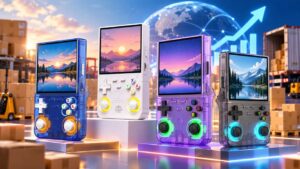
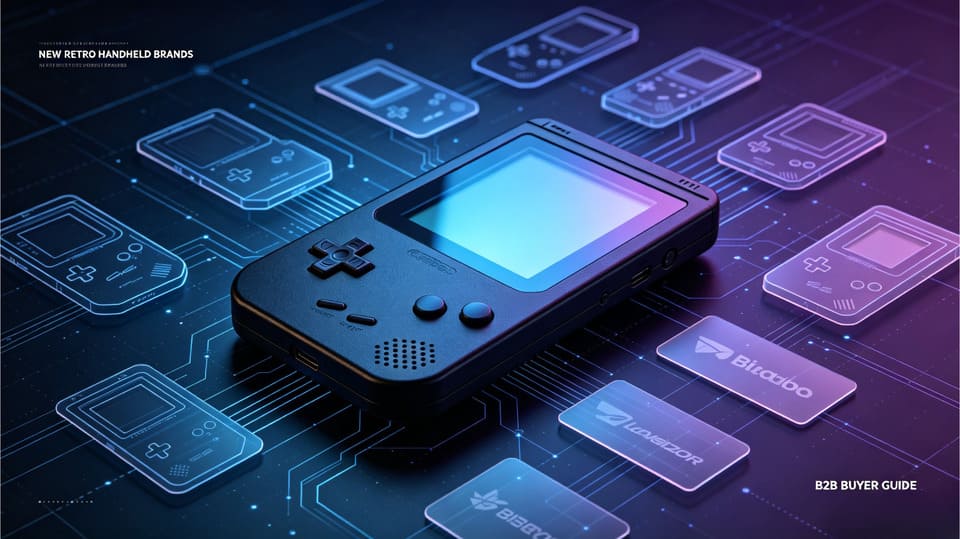

Retro handheld brands are launching faster than many B2B buyers can evaluate them. That sounds exciting, but it also creates risk: unstable supply, inconsistent quality, copycat products, and weak after-sales support1. I usually tell buyers to slow down, test small, and choose brands with real manufacturing depth.
B2B buyers should choose retro handheld brands by checking four things: supply chain strength, product update rhythm, community reputation, and B2B cooperation ability.2 A good brand usually has factory control, 2–3 meaningful product updates per year3, positive Reddit and YouTube feedback, and flexible OEM/ODM support for bulk buyers.
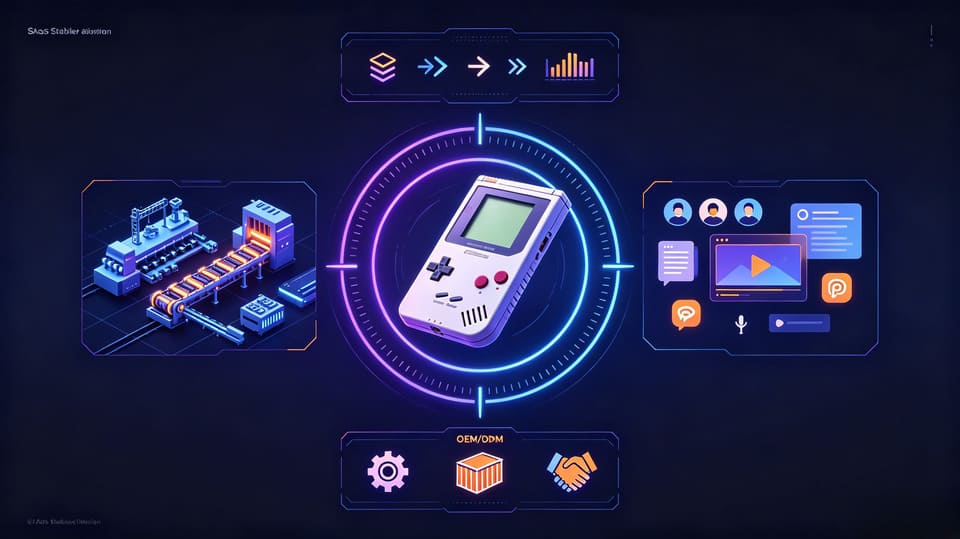
The market will keep moving quickly in 2026. The smart approach is not to chase every new console. It is to build a simple filter, test 2–3 models in small batches, and let real sales data decide.
What handhelds are coming out in 2026, and which retro handheld brands should buyers watch?
New handhelds in 2026 will likely focus on stronger chipsets, better screens, Android/Linux systems, cloud gaming, and premium shells4. The problem is that not every new model will become a stable wholesale product.
The best 2026 handhelds for B2B buyers will be models with reliable production, clear positioning, and proven user demand. Buyers should watch brands that can update hardware, improve firmware, and maintain stable supply instead of only launching one hot product.
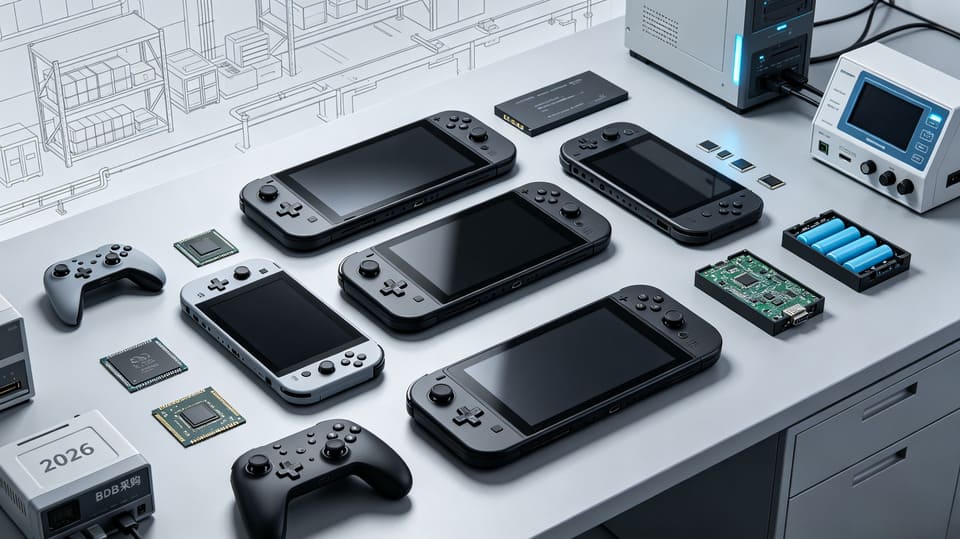
How I would filter 2026 products
When I look at upcoming handheld consoles, I do not only ask, “Is this product cool?” I ask, “Can this product sell repeatedly for six months without causing headaches?”
That difference matters a lot for wholesalers, Amazon sellers, Shopify sellers, and distributors.
I usually check:
- Factory background: Does the brand have its own production line, or is it only a trading label?
- Delivery control: Can it ship during peak seasons?
- QC process: Are screens, buttons, batteries, speakers, and charging ports tested?
- Firmware support: Can bugs be fixed after launch?
- OEM space: Can I customize logo, packaging, game list, UI, or shell color?
| Buyer Concern | Good Signal | Risk Signal |
|---|---|---|
| Supply | Own factory or stable manufacturing partner | Pure white-label sourcing |
| Quality | Batch testing and QC reports | Random product consistency |
| Updates | 2–3 upgrades yearly | One model, then silence |
| B2B support | Flexible MOQ and customization | Only C-end direct selling |
From my experience, a brand with its own factory is usually safer5. It can control quality, delivery, and later OEM projects. A pure-label brand may change suppliers anytime, which makes consistency hard to guarantee.6
What are the trends in the retro handheld brands market?
The retro handheld market is moving from simple “built-in game” devices to more polished, differentiated, and channel-ready products.7 Buyers now need to think about user experience, packaging, compliance, and repeat sales.
Key trends include larger HD screens, better emulation performance, dual-system support, HDMI output, Wi-Fi features, customized UI, and gift-ready packaging. For B2B buyers, the biggest trend is product differentiation because price competition is becoming stronger8.
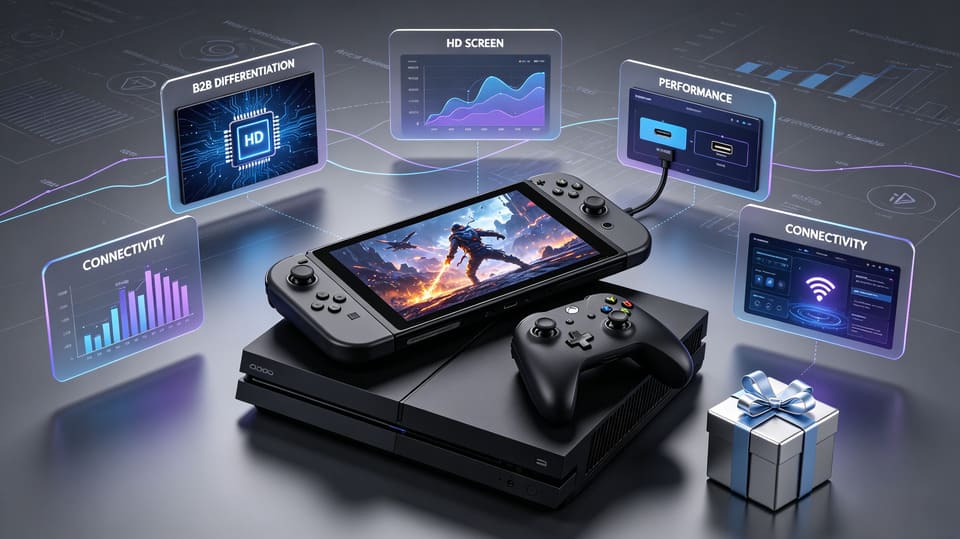
Trends that actually matter for B2B
Some trends look impressive online but do not always convert into profit. For example, a very powerful chipset may attract enthusiasts, but it can also raise cost, heat, and return risk9. A balanced product often sells better in wholesale channels.
I pay more attention to these practical trends:
-
Better screens Buyers like 3.5-inch to 7-inch displays with clearer color and higher brightness.
-
More stable systems Linux-based systems are simple and low-cost. Android models offer more flexibility but need better optimization.10
-
Retail-ready packaging Amazon and offline retailers need strong boxes, clear manuals, and attractive images.
-
Private label demand More sellers want their own logo, packaging, boot screen, and user interface.
-
Lower return rates A cheap product is not cheap if buttons fail, batteries swell, or users leave bad reviews.
For B2B, the winning product is not always the most powerful one. It is the one that balances cost, quality, supply, and customer satisfaction.
This is why I advise new buyers to test small first. A 10-unit trial order can reveal real market feedback before placing a larger order.
What techniques do game makers use to entice potential consumers?
Game makers attract consumers through nostalgia, limited editions, influencer reviews, better visuals, large game libraries, and social proof. These techniques work because buyers want both emotion and value.
The most effective techniques are nostalgia marketing, YouTube demonstrations, community reviews, bundle offers, custom colors, and “ready-to-play” convenience11. For B2B buyers, these same techniques can improve product listings, retail displays, and conversion rates.
What sellers can learn from this
A retro handheld is not only a hardware product. It is also an emotional product. Many consumers buy it because it reminds them of childhood gaming, travel, school breaks, or old arcade memories.
That is why strong marketing usually uses:
- Nostalgia: “Play classic games anywhere.”
- Convenience: “No setup, ready to play.”
- Portability: “Pocket-size entertainment.”
- Gift value: “Great for birthdays, holidays, and family time.”
- Social proof: YouTube reviews, Reddit comments, TikTok demos.
- Visual appeal: Transparent shells, bright colors, premium packaging.
For B2B buyers, this means product selection should match the sales channel.
| Channel | Best Product Angle |
|---|---|
| Amazon | Low return rate, strong images, good reviews |
| Shopify | Brand story, custom packaging, bundles |
| Retail stores | Attractive box, simple demo, gift appeal |
| Wholesale | Stable supply, competitive pricing, repeat models |
I always recommend checking Reddit communities like r/retrogaming and r/EmulationOnAndroid. YouTube reviews are also useful. Real user complaints often reveal issues that supplier brochures will never mention.12
What is the next handheld console coming out from retro handheld brands?
The next handheld console will likely be a more powerful, better-designed device with improved emulation, stronger battery life, and more polished software. However, B2B buyers should care less about “next” and more about “stable.”
The next good handheld console for B2B is one that has confirmed production capacity, tested firmware, clear target users, and available customization. A new model is only worth buying if the supplier can support quality, delivery, and after-sales communication.
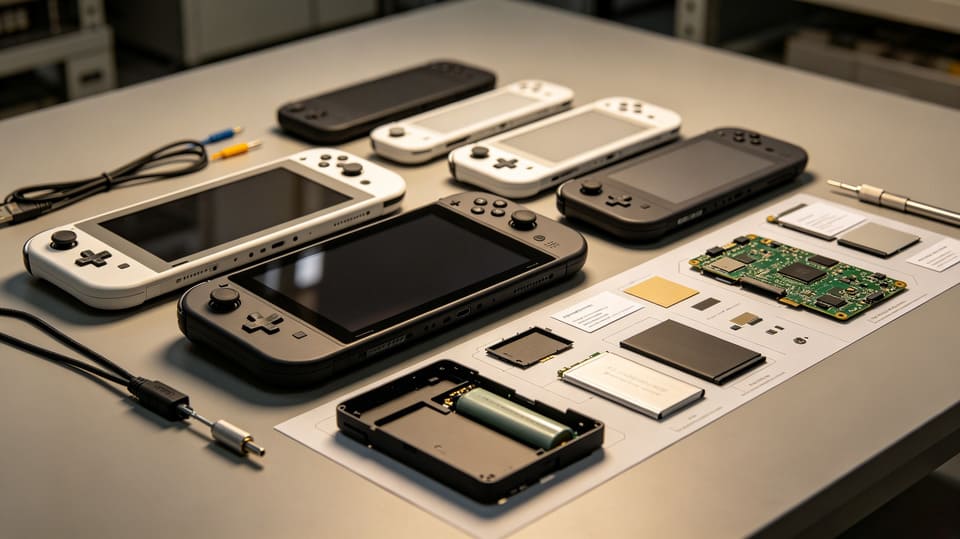
My practical buying rule
I never suggest betting big on a new model immediately. The smarter move is to test 2–3 products with small quantities. This is exactly why flexible MOQ matters.
At Kalefu, for example, small trial orders can help buyers test:
- Real customer interest
- Packaging response
- Product defect rate
- Review quality
- Reorder potential
- Best-selling colors or bundles
The four-part filter is simple:
-
Supply chain depth A brand with real production resources is safer than a pure label.
-
Product iteration rhythm A good brand releases 2–3 new or improved models per year.
-
Community reputation Reddit and YouTube feedback often shows the truth.
-
B2B cooperation Fast replies, flexible MOQ, OEM options, and stable delivery matter more than hype.
If a brand only sells to consumers and treats B2B buyers as an afterthought, I would be careful. A factory that supports logo printing, custom packaging, firmware changes, and bulk delivery usually has much higher long-term value.
Frequently Asked Questions
How can B2B buyers avoid risky retro handheld brands?
Buyers should avoid brands with no factory background, no update history, poor community feedback, and slow communication. I suggest starting with a small test order, checking quality carefully, and only scaling after the product proves stable in real sales.
Is a factory brand better than a pure trading brand?
Usually, yes. A factory-backed brand can control production, QC, delivery, and customization better. A pure trading brand may still work, but product consistency and long-term supply can be harder to manage.
What MOQ is best for testing new handheld consoles?
For new models, a low MOQ is best. A 10-unit trial order is useful because buyers can test market response, product quality, packaging, and customer feedback before committing to larger inventory.
Should Amazon sellers choose different handhelds than wholesalers?
Yes. Amazon sellers need strong packaging, low defect rates, good photos, and review-friendly quality. Wholesalers focus more on stable supply, pricing, and repeat availability. The best model depends on the sales channel.
Conclusion
Retro handheld brands will keep launching new models, but B2B buyers should not follow hype blindly. The safer path is to check supply chain strength, product updates, community reputation, and B2B support. If you want to test reliable retro handhelds with OEM/ODM options, Shenzhen Kalefu Electronics can support small trial orders, custom packaging, and scalable production for global buyers.
"Mapping Global Trade in Fakes 2025", https://www.oecd.org/en/publications/mapping-global-trade-in-fakes-2025_94d3b29f-en.html. Institutional research on electronics supply chains and counterfeit goods documents risks related to product authenticity, quality control, delivery reliability, and post-sale accountability, providing contextual support for the risk factors identified here. Evidence role: general_support; source type: institution. Supports: A neutral institutional source should support that electronics supply chains can face counterfeit goods, quality variability, delivery disruption, and service risks.. Scope note: The source may address electronics supply chains broadly rather than retro handheld consoles specifically. ↩
"Supply chain management", https://en.wikipedia.org/wiki/Supply_chain_management. Peer-reviewed supplier-selection literature commonly identifies quality capability, delivery reliability, flexibility, communication, service, and supplier reputation as recurring procurement criteria, which provides contextual support for this four-part B2B evaluation framework. Evidence role: expert_consensus; source type: paper. Supports: A scholarly source should show that supplier capability, quality, delivery reliability, flexibility, communication, and reputation are common supplier-selection criteria.. Scope note: The evidence would validate the procurement logic generally, not the exact four-factor framework for retro handheld brands. ↩
"Bluetooth", https://en.wikipedia.org/wiki/Bluetooth. Research on consumer-electronics product lifecycles shows that frequent product refreshes and short development cycles are common competitive practices in fast-moving hardware categories, offering contextual support for using update rhythm as a brand-evaluation signal. Evidence role: general_support; source type: research. Supports: A research source should support that consumer electronics markets often rely on regular product refreshes and short product lifecycles.. Scope note: Such evidence is unlikely to prove the exact threshold of 2–3 updates per year for retro handhelds. ↩
"Android (operating system)", https://en.wikipedia.org/wiki/Android_(operating_system). Technology-market research on portable gaming and cloud gaming identifies processor performance, display quality, operating-system ecosystems, and streaming capability as important development areas, giving contextual support to the projected feature direction described here. Evidence role: general_support; source type: research. Supports: A neutral market or technology research source should support broader trends toward improved processors, displays, operating-system flexibility, and cloud gaming in portable gaming devices.. Scope note: The source would support broader portable-gaming trends and may not directly forecast retro handheld launches in 2026. ↩
"Vertical integration", https://en.wikipedia.org/wiki/Vertical_integration. Supply-chain research on vertical integration and supplier coordination finds that greater control over production can improve information flow, quality oversight, and delivery coordination, which provides a mechanism for why factory-backed brands may reduce procurement risk. Evidence role: mechanism; source type: paper. Supports: A scholarly source should explain how vertical integration or closer manufacturing control can affect quality control, coordination, and delivery reliability.. Scope note: The evidence would support the mechanism generally rather than prove that every factory-owned retro handheld brand is safer. ↩
"Supply chain management", https://en.wikipedia.org/wiki/Supply_chain_management. Academic work on supplier switching and outsourced manufacturing links changes in production partners to coordination costs, learning effects, and potential quality variation, supporting the concern that pure-label sourcing can complicate consistency control. Evidence role: mechanism; source type: paper. Supports: A research source should support that supplier switching and outsourced production can introduce coordination problems or quality variability.. Scope note: The source would describe general supply-chain dynamics and may not study retro handheld brands directly. ↩
"Handheld game console", https://en.wikipedia.org/wiki/Handheld_game_console. Historical accounts of handheld game consoles describe a progression from simple dedicated devices toward more capable portable systems with improved displays, processors, connectivity, and software ecosystems, providing background context for this market-evolution claim. Evidence role: historical_context; source type: encyclopedia. Supports: An encyclopedia or historical source should show the broader evolution of handheld gaming devices from simple dedicated units to more capable portable systems.. Scope note: This would establish historical context for handheld consoles generally, not a quantitative analysis of the current retro handheld wholesale market. ↩
"Technological Tying and the Intensity of Price Competition", http://www.contrib.andrew.cmu.edu/~derdenge/TechnologicalTying.pdf. Research on consumer-electronics competition shows that product commoditization and a growing number of comparable devices can intensify price pressure, offering contextual support for the claim that differentiation matters as competition strengthens. Evidence role: general_support; source type: research. Supports: A market or academic source should support that consumer electronics categories often experience price pressure as products become commoditized and competitors increase.. Scope note: The evidence may address consumer electronics broadly and may not provide retro-handheld-specific pricing data. ↩
"Run-time estimation of system and sub-system level power ...", https://en.wikipedia.org/wiki/Run-time_estimation_of_system_and_sub-system_level_power_consumption. Engineering literature on mobile processors and thermal design shows that higher computational performance is commonly constrained by power consumption, heat dissipation, battery capacity, and component cost, supporting the technical trade-off described here. Evidence role: mechanism; source type: paper. Supports: A technical paper should support the relationship between processor performance, power consumption, thermal output, and device design constraints.. Scope note: The evidence would directly support cost and heat mechanisms but may not directly measure product-return risk for retro handhelds. ↩
"List of open-source hardware projects", https://en.wikipedia.org/wiki/List_of_open-source_hardware_projects. Research comparing embedded Linux and Android notes that Linux-based systems are widely used in cost-sensitive embedded devices, while Android provides a broader application framework but can introduce optimization and fragmentation challenges across hardware configurations. Evidence role: mechanism; source type: paper. Supports: A technical source should explain how embedded Linux and Android differ in licensing, customization, hardware requirements, fragmentation, and optimization needs.. Scope note: The source would support operating-system trade-offs generally and may not evaluate retro handheld implementations specifically. ↩
"Psychology of eating meat", https://en.wikipedia.org/wiki/Psychology_of_eating_meat. Consumer-behavior research links nostalgia appeals, social proof from reviews, product bundling, customization cues, and convenience framing with purchase intention, providing scholarly context for the marketing techniques listed here. Evidence role: general_support; source type: paper. Supports: Scholarly marketing sources should support that nostalgia, social proof, video reviews, bundling, customization, and convenience can influence purchase intention.. Scope note: The evidence would support these techniques across consumer markets and may not test all of them together in retro handheld sales. ↩
"Substandard and falsified medical products", https://www.who.int/news-room/fact-sheets/detail/substandard-and-falsified-medical-products. Research on online consumer reviews finds that user complaints often contain diagnostic information about defects, usability problems, and reliability concerns, supporting their use as a supplementary source for product-quality assessment. Evidence role: general_support; source type: paper. Supports: A scholarly source should support that user reviews and complaints can reveal quality defects, usability issues, and product-performance problems.. Scope note: The evidence would support the informational value of reviews generally, not guarantee that every Reddit or YouTube complaint is accurate. ↩