
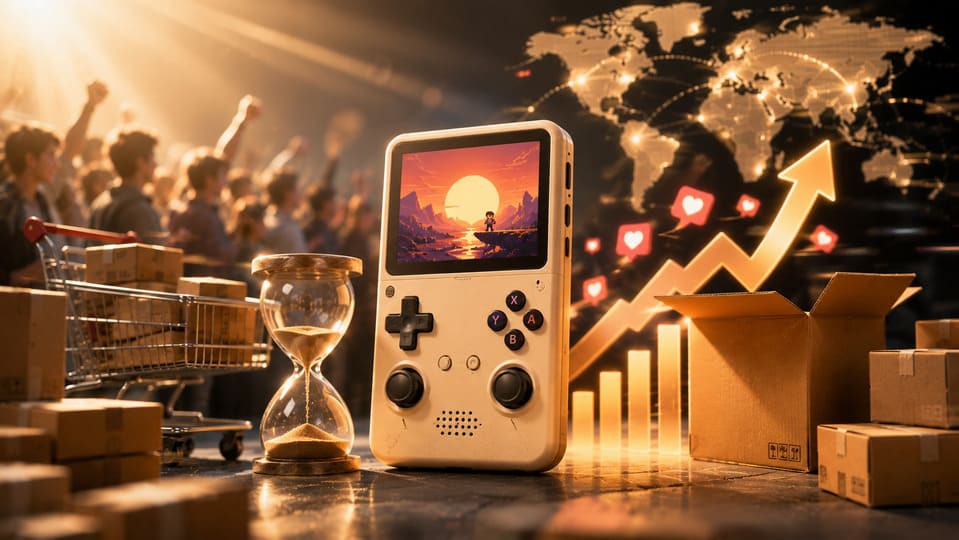

A retro handheld selling 15,000 units in 48 hours looks like sudden luck. But when I look at it from the factory side, I see something more practical: buyers are chasing affordable, giftable, easy-to-sell gaming products. If you miss that signal, you may miss the next fast-moving category.
A retro handheld selling out in two days shows that buyer demand is strongest where price, nostalgia, portability, and impulse buying meet1. In my view, the real signal is not only the 15,000 units sold, but the clear gap in the $30–$50 price range2 for distributors, retailers, and e-commerce sellers.
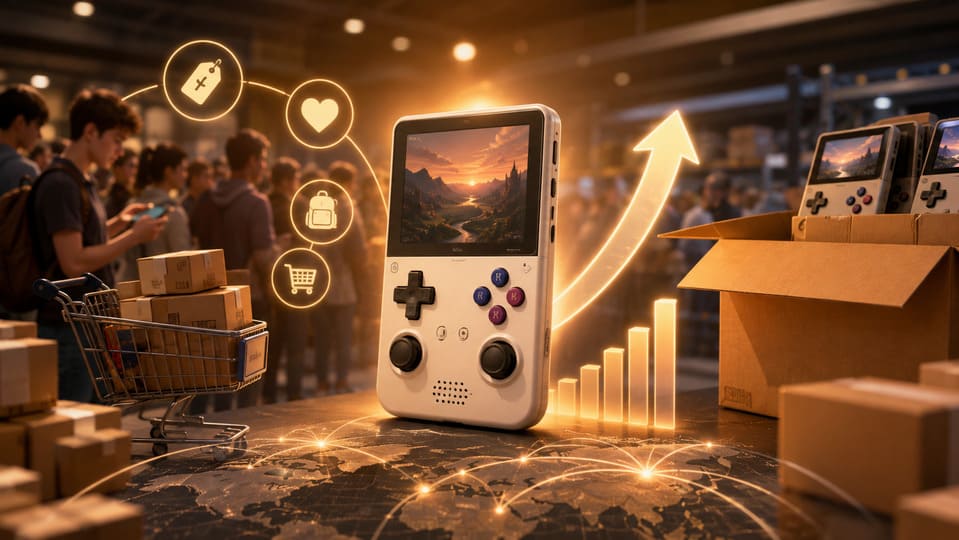
I have worked in game console manufacturing for more than 10 years. I have seen many products “explode overnight.” Most of them were not accidents. They hit the right product position before the market became crowded.
Why Did This Retro Handheld Sell Out So Fast?
A retro handheld can sell fast when it is simple to understand, easy to gift, and priced low enough for impulse purchase. Buyers do not need a long education cycle3. They see the screen, the games, the nostalgia, and the price. Then they make a quick decision.
From my factory-side view, KONKR selling 15,000 units in two days points to three clear demand drivers:
| Demand Driver | Why It Matters |
|---|---|
| $30–$50 price band4 | Low risk for consumers and easier bulk buying for sellers |
| Retro gaming appeal | Strong emotional value across different age groups5 |
| Portable format6 | Better for gifting, travel, and social media content |
This price range is important. In my customer base, inquiries for products around $30–$50 have increased by at least 40% this year, especially from social media sellers and offline retail buyers.
I do not see this as just “hot traffic.” I see it as a product-market fit signal. Many buyers want something cheaper than premium handheld consoles but better than low-quality toys. That middle space is where many orders are moving now.
What Does Retro Handheld Demand Mean for Wholesalers and Retailers?
For wholesalers and retailers, retro handheld demand means faster product testing, smaller risk per unit, and stronger seasonal sales potential7. The product is especially suitable for holiday promotions, bundle offers, online ads, and offline display shelves.
I would not suggest buyers simply chase every sold-out model. That is risky. Instead, buyers should study why the product moved:
- Was the price attractive?
- Was the design easy to understand?
- Was the game library broad enough?
- Was the packaging suitable for gifting?
- Was the supplier able to restock quickly?
For distributors, the biggest risk is not missing one model. The bigger risk is choosing a supplier who cannot keep quality stable when volume rises8.
A fast-selling handheld may look simple, but mass production still needs control:
- Screen consistency
- Battery stability9
- Button life testing
- PCB inspection
- Firmware and game list checking
- Packaging drop protection
- Final random inspection before shipment
At Shenzhen Kalefu Electronics, I always remind buyers that a good sample does not automatically mean good mass production. Buyers should verify factory capacity, QC process, export experience, and customization ability10 before placing larger orders.
How Should Buyers Source a Retro Handheld Supplier?
Buyers should source a retro handheld supplier by checking production capacity, quality control, customization options, communication speed, and export experience. A low unit price is useful, but stable delivery and low defect rates often matter more for long-term profit11.
Here is a simple supplier checklist I recommend:
| Evaluation Point | What to Check |
|---|---|
| Factory experience | Years in gaming console manufacturing |
| Production capacity | Number of production lines and monthly output |
| QC process | Incoming material check, assembly test, final inspection |
| OEM/ODM support | Logo, shell color, UI, packaging, game library |
| Export readiness | Shipping experience to your target market |
| After-sales support | Response speed and defect handling process |
For brand owners, OEM/ODM ability is especially important. A standard model may sell for a short time, but customized packaging, UI, colors, and bundles help create a stronger brand identity.
For Amazon, Shopify, and TikTok sellers, I usually suggest testing with a controlled first order. Then buyers can scale based on real conversion rate, return rate, and customer reviews.
A hot product can bring traffic. A stable supplier helps you keep the profit.
Frequently Asked Questions
Is the retro handheld market still growing?
Yes, demand remains active, especially in the affordable gaming segment. Buyers are looking for portable, nostalgic, and gift-friendly products. The strongest movement I see is in the $30–$50 retail price range.
Why is the $30–$50 price band important?
This price range lowers purchase hesitation. Consumers can buy it as a gift or impulse product. For wholesalers and e-commerce sellers, it also allows better pricing flexibility and easier bulk testing.
What should I check before ordering retro handheld consoles?
You should check samples, screen quality, battery performance, button feel, game list, packaging, certifications, and supplier QC process. Buyers should also verify any compliance documents needed for their target market.
Can retro handheld consoles be customized?
Yes. Common OEM/ODM options include logo printing, shell color, packaging design, UI changes, hardware configuration, and built-in game library customization. Customization depends on order quantity and project requirements.
Conclusion
The 15,000-unit sellout shows that retro handheld demand is not just hype. It reflects a clear market gap in affordable, portable gaming products. From my manufacturing experience, the best buyers will not only chase the hot model. They will evaluate price position, quality stability, supplier capacity, and customization potential. If you are planning a retro gaming product line, Shenzhen Kalefu Electronics can support OEM/ODM development, factory production, and worldwide shipping.
"Nostalgia", https://en.wikipedia.org/wiki/Nostalgia. Research on nostalgia marketing and impulse purchasing indicates that nostalgic cues, perceived convenience, and lower perceived financial risk can increase consumer purchase intention, providing contextual support for the article’s explanation of retro handheld demand. Evidence role: general_support; source type: paper. Supports: The source should support the broader idea that nostalgia, convenience, and price can influence consumer purchase intention or impulse buying.. Scope note: Such research supports the behavioral mechanism in general but may not measure this exact product category or price range. ↩
"Handheld game console", https://en.wikipedia.org/wiki/Handheld_game_console. Market research on portable gaming devices identifies budget-oriented handheld products as a distinct segment below premium console pricing, giving contextual support to the article’s claim that the $30–$50 range may represent a meaningful market opening. Evidence role: general_support; source type: research. Supports: The source should show that affordable portable gaming products occupy a distinct low-price segment or that consumer demand exists for budget gaming devices.. Scope note: A general market report can support the existence of a budget segment but may not directly prove an unfilled gap at exactly $30–$50. ↩
"Factors Affecting Impulse Buying Behavior of Consumers - PMC", https://pmc.ncbi.nlm.nih.gov/articles/PMC8206473/. Consumer-behavior research on low-involvement purchases indicates that familiar and easily understood products often require less information search and shorter evaluation, supporting the article’s claim that a simple retro handheld may not require extensive buyer education. Evidence role: mechanism; source type: paper. Supports: The source should explain how product familiarity, simplicity, or low involvement can shorten consumer decision-making.. Scope note: The research supports the decision-making mechanism generally and does not measure this specific handheld model. ↩
"Exploring consumer perceived risk and purchase intention of ...", https://pmc.ncbi.nlm.nih.gov/articles/PMC9872014/. Studies of price sensitivity and perceived risk find that lower purchase prices can reduce consumer deliberation and perceived loss exposure, supporting the article’s argument that a $30–$50 device is easier to position for impulse purchases and small-scale retail testing. Evidence role: mechanism; source type: paper. Supports: The source should explain how lower price points can reduce perceived purchase risk and increase willingness to buy or test a product.. Scope note: The evidence explains the pricing mechanism generally and does not establish that $30–$50 is the optimal threshold for every market. ↩
"Nostalgia", https://en.wikipedia.org/wiki/Nostalgia. Research on video game nostalgia shows that earlier gaming experiences can create affective attachment and renewed engagement among adult players, supporting the article’s claim that retro gaming carries emotional value beyond a single age group. Evidence role: expert_consensus; source type: paper. Supports: The source should show that nostalgia in games can create emotional attachment or appeal among adult consumers and across age cohorts.. Scope note: The evidence supports nostalgia as an emotional driver but may not quantify appeal for every age group or region. ↩
"The role of mobile gaming habits, context, and platform - PMC", https://pmc.ncbi.nlm.nih.gov/articles/PMC9379297/. Studies of mobile and handheld gaming emphasize portability and convenience as key factors enabling play across locations and contexts, providing contextual support for the article’s claim that a portable format improves practical appeal. Evidence role: general_support; source type: paper. Supports: The source should support the idea that portability increases convenience and situational use of gaming or entertainment devices.. Scope note: This supports portability as a usage advantage but does not directly prove that portability increases gifting or social-media performance for this product. ↩
"The 2025 Winter Holiday Season", https://www.census.gov/newsroom/facts-for-features/2025/holiday-season.html. Holiday retail surveys and sales data consistently identify electronics and giftable consumer products as important seasonal purchase categories, supporting the article’s view that affordable handheld gaming devices may have holiday sales potential. Evidence role: statistic; source type: institution. Supports: The source should show that electronics, toys, or giftable consumer products experience significant holiday-season demand.. Scope note: The evidence supports the seasonality of adjacent categories but does not directly forecast sales for a particular retro handheld. ↩
"Six Sigma", https://en.wikipedia.org/wiki/Six_Sigma. Operations-management literature on production ramp-up notes that higher output can expose process variability and increase quality-control demands, supporting the article’s caution that suppliers may struggle to keep quality stable as volume rises. Evidence role: mechanism; source type: paper. Supports: The source should explain that production ramp-up can increase process variability, defect risk, or quality-control burden.. Scope note: The source supports the manufacturing mechanism generally and may not be specific to handheld game consoles. ↩
"Batteries | CPSC.gov", https://www.cpsc.gov/Regulations-Laws--Standards/Voluntary-Standards/Topics/Batteries. Government safety guidance on lithium-ion batteries in consumer products identifies overheating, fire, and failure risks, supporting the article’s inclusion of battery stability as a key quality-control checkpoint for portable electronics. Evidence role: general_support; source type: government. Supports: The source should support the need to evaluate lithium-ion or rechargeable battery safety in portable consumer electronics.. Scope note: The guidance supports battery safety review generally and does not evaluate the batteries used in any specific retro handheld. ↩
"Prequalification Team Inspection services", https://extranet.who.int/prequal/sites/default/files/whopir_files/WHOPIR_AgroquimicosVersa27-29July2022.pdf. Quality-management and procurement frameworks emphasize evaluating suppliers by capability, quality controls, delivery performance, and conformity requirements, supporting the article’s recommendation to verify factory capacity and QC processes before scaling orders. Evidence role: expert_consensus; source type: institution. Supports: The source should support structured supplier evaluation, including quality controls, capability, and delivery or export competence.. Scope note: The framework supports supplier evaluation principles but does not prescribe the exact checklist used for retro handheld sourcing. ↩
"Reliability engineering", https://en.wikipedia.org/wiki/Reliability_engineering. Research on total cost of ownership and cost of poor quality shows that defects, rework, returns, and delivery failures can materially increase procurement costs, supporting the article’s claim that stable delivery and low defect rates may be more important than the lowest unit price. Evidence role: mechanism; source type: paper. Supports: The source should show that defects, returns, delays, and quality failures can create costs that outweigh a lower purchase price.. Scope note: The evidence supports the cost mechanism broadly and does not calculate profitability for this specific product line. ↩